
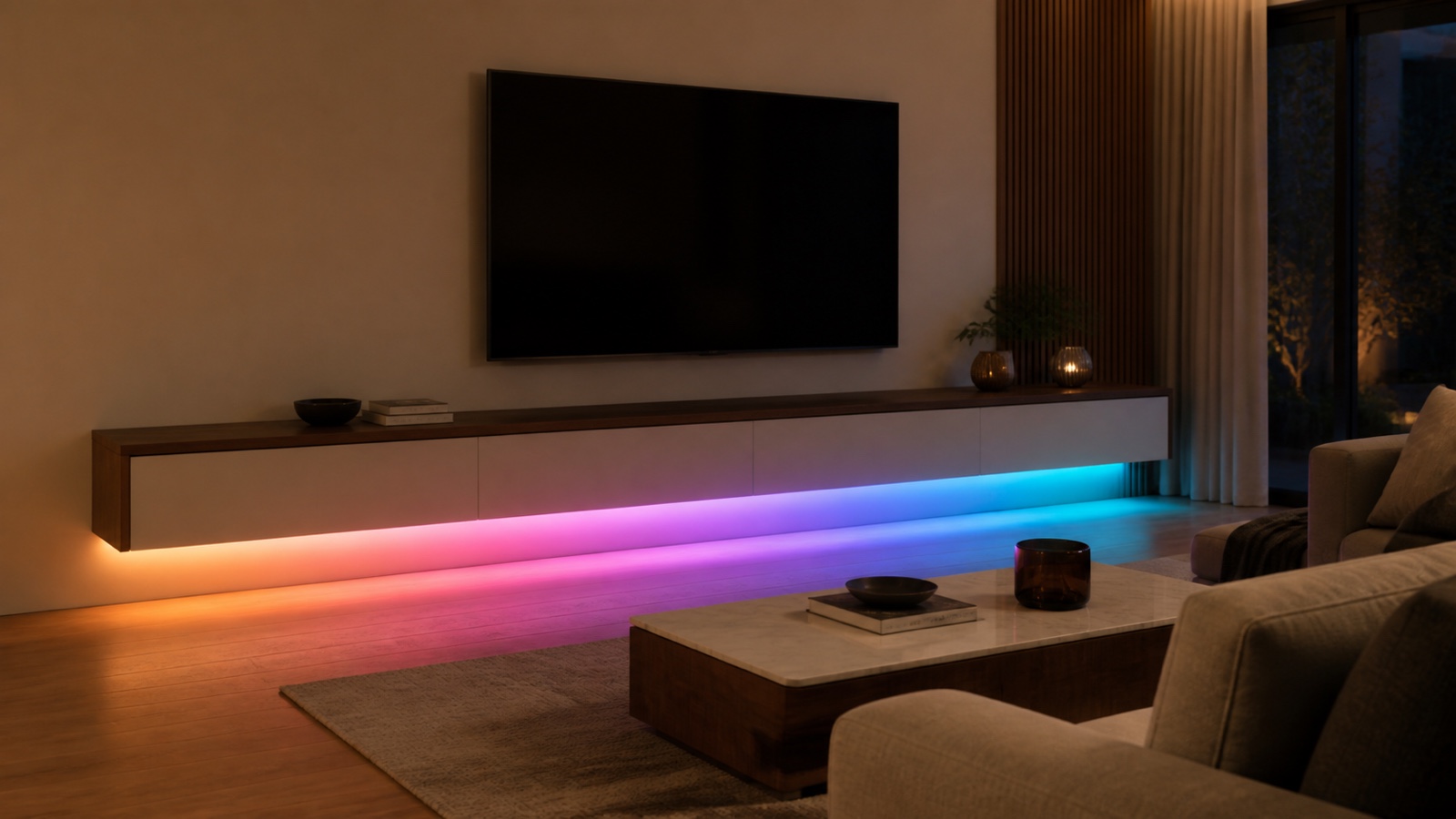
RGBIC LED strip is a broad product category, but it is not a complete purchasing specification. Two products sold as "RGBIC" can use different control ICs, voltages, pixel groupings, data methods, cut intervals, power-feed plans, and controller requirements. They may create similar rainbow effects in a short demonstration and behave very differently in a commercial installation.
Before requesting samples or quotations, buyers should compare the addressable architecture, control resolution, voltage, controller, power distribution, and physical construction. Suppliers also need complete project information to recommend a usable system rather than an isolated reel of tape.
1. Quick answer: what should an RGBIC buyer specify?
Start with the required visual effect and system architecture, then select the strip.
| Buying checkpoint | What to specify |
|---|---|
| Control resolution | Each LED, each IC, or a group of LEDs controlled as one pixel. |
| IC and protocol | Exact IC model or compatible protocol, data format, channel order, and controller platform. |
| Voltage | 5V, 12V, or 24V based on the strip architecture, run length, current, cut interval, and power-distribution plan. |
| Pixel and LED density | LEDs per meter, pixels per meter, and LEDs per controlled pixel. |
| Color architecture | RGB, RGBW, RGB+CCT, or another channel configuration required by the project. |
| Length and layout | Total length, individual run lengths, corners, branches, feed locations, and distance from controller to strip. |
| Power data | Maximum W/m and A/m for the actual operating mode, power-supply loading, cable size, voltage-drop limit, and fused feed plan. |
| Signal design | Data direction, number of controller outputs, pixel count per output, signal distance, level shifting, repeaters, or differential transmission where required. |
| Construction | PCB width and color, cut unit, connector, adhesive, IP level, silicone structure, profile, operating temperature, and installation method. |
| Sample test | The exact strip, controller, firmware, power supply, wiring, animation, brightness, color mode, and representative run length. |
Do not approve an RGBIC LED strip from LED density or a short rainbow video alone. The buyer must confirm how many independently controlled pixels exist, how they are addressed, how the system is powered, and whether the intended controller can update the required pixel count at the required effect speed.
2. What does RGBIC mean in a purchasing specification?
RGBIC generally describes an RGB LED product that includes integrated-circuit control so different pixels or zones can display different colors at the same time. In product catalogs and project discussions, the same product category may also be called:
- addressable LED strip;
- programmable LED strip;
- digital LED strip;
- pixel LED strip;
- dream-color or dynamic RGB strip; or
- SPI LED strip, when the product uses a compatible serial control method.
These terms overlap, but they are not formal guarantees of identical construction or performance. "RGBIC" does not state:
- the IC part number;
- whether the IC is built into the LED package or mounted separately on the PCB;
- whether one LED or several LEDs form one controlled pixel;
- whether the product has RGB or a dedicated white channel;
- whether the strip uses one data line, data plus clock, or a main and backup signal path;
- its operating voltage, data timing, PWM behavior, or refresh performance; or
- which controller and firmware support it.
An RFQ should not stop at the word RGBIC. It should continue with model-level IC, pixel, electrical, controller, and construction specifications.
3. RGB, RGBW, RGBIC and RGBICW: the commercial difference
A conventional analog RGB strip normally uses separate red, green, and blue power channels. A compatible controller changes the channels for the connected strip or zone together. It is suitable when the whole run can show one color at a time and complex moving effects are unnecessary.
An RGBIC or addressable RGB strip adds control electronics along the strip. The controller sends digital color data in sequence, allowing different controlled pixels to show different colors. This supports chases, gradients, moving patterns, progress indicators, interactive effects, and mapped animations.
RGBW adds a dedicated white channel. Addressable RGBW, also commonly labeled RGBICW, can provide dynamic color plus a separate white emitter. However, the presence of a white channel does not automatically prove a particular CCT, CRI, R9 value, bin consistency, or usable illumination quality. Those parameters still need to be specified and tested.
| Type | Control and suitable use | Limitation |
|---|---|---|
| Analog RGB | One color state per connected zone; simple accents and cost-sensitive projects | No pixel-level moving effects. |
| Analog RGBW | Zone-level RGB plus white; accents needing a more usable white mode | Connected segments normally change together. |
| RGBIC / addressable RGB | Pixel or segment control for chasing, gradients, signage, entertainment, and interactive scenes | Requires matched protocol, controller, signal, and power. |
| RGBICW / addressable RGBW | Addressable color plus white for dynamic scenes needing a dedicated white output | Higher channel, controller, power, and specification complexity. |
If white light is the primary purpose, do not select RGBICW from the label alone. Request white-channel CCT, electrical load, color data, and a lit sample. A high-CRI fixed-white or tunable-white system may still be the better lighting product, while RGBIC supplies the decorative effect.
4. Built-in IC vs external IC: why the PCB structure matters
Addressable strips commonly use one of two construction paths.
Built-in IC LED packages
The LED package combines the RGB emitters and control electronics. This can support compact layouts and, on many common 5V products, control of each package as one pixel. The exact package, current setting, protocol, color order, data timing, and failure behavior still depend on the IC revision and strip design.
External IC architecture
A separate driver IC is mounted on the PCB and controls one or more RGB LED packages. This gives the strip designer more freedom to create 5V, 12V, or 24V circuits and different LED-per-pixel groupings. It also means buyers cannot infer pixel density from LED density.
Neither architecture is automatically better. Choose from the project requirements:
- Built-in IC products are useful when compact per-package control and high visual resolution are priorities.
- External IC products are useful when the design needs other voltage paths, grouped pixels, different power distribution, or a particular cost/performance structure.
Before approving either type, request a PCB close-up and a control map that labels the IC, LEDs controlled by each IC, cut points, data direction, power terminals, and connector pinout.
5. How to compare common RGBIC LED strip IC families
IC names are useful model identifiers, but an IC family name is not a complete strip specification. Revisions, clones, current settings, PCB circuits, and controller implementations can differ.
| IC family | Typical architecture | Verify before ordering |
|---|---|---|
| WS2812B type | Integrated RGB control, commonly 5V and one LED package per pixel | Exact IC revision, voltage, channel order, data timing, current, density, PWM behavior, and controller support. |
| WS2811 type | External RGB driver used in multiple strip voltages and segment designs | Voltage, LEDs per pixel, cut unit, current setting, data timing, pixel count, and whether the controller profile matches the supplied strip. |
| SK6812 type | Integrated addressable family with RGB and RGBW variants | Exact RGB or RGBW model, white-channel CCT, voltage, channel order, timing, current, and controller support. |
| WS2815 type | Commonly a 12V integrated RGB path with main and backup data on applicable products | Exact dual-signal wiring, failure bypass behavior, power consumption, logic requirements, and controller compatibility. |
| SM16703 / UCS external ICs | Used in varied programmable strip constructions | Exact IC datasheet, protocol profile, voltage, grouping, color order, controller firmware, and replacement compatibility. |
| Clocked data families | Separate data and clock paths can suit some high-update or timing-sensitive systems | Required wiring, controller outputs, clock/data limits, EMI control, and software support. |
Do not copy a generic comparison table into a purchase order. The approved sample, supplier datasheet, controller configuration, and production model must all identify the same IC and revision.
What about "breakpoint resume" or backup data?
Some addressable architectures include a backup signal route intended to let data pass a failed pixel or use dual inputs. This can reduce the effect of certain single-point failures, but it is not a complete reliability guarantee. It does not correct:
- a lost power feed;
- excessive voltage drop;
- damaged wiring or connectors;
- controller failure;
- multiple adjacent failures; or
- an incorrect signal design.
Ask the supplier to show the exact wiring logic and define which failure condition the feature is designed to tolerate.
6. Pixel density is not the same as LED density
This is one of the most important RGBIC purchasing checks.
LED density is the number of LED packages per meter.
Pixel density is the number of independently controlled units per meter.
If every LED package contains its own IC and is controlled independently, 60 LEDs/m may also mean 60 pixels/m. If one external IC controls three LEDs together, 60 LEDs/m may mean 20 controlled pixels/m. Other groupings are possible.
For a sign, display, or visible chasing line, pixel pitch affects how smooth motion and gradients appear. For a concealed cove or distant facade, a lower pixel density may be acceptable and can reduce controller load and data volume. The required result depends on viewing distance, diffuser depth, animation speed, camera use, and the physical scale of the effect.
Ask for these three values separately:
- LEDs per meter;
- ICs or controlled pixels per meter; and
- LEDs controlled by each pixel.
Also confirm whether the cut unit equals one pixel. Never cut between the LEDs of a grouped electrical segment unless the product drawing explicitly allows it.
7. 5V vs 12V vs 24V RGBIC LED strip
Voltage selection affects current, circuit topology, cut interval, controller choice, power injection, cable size, and installation labor. It does not by itself define brightness, pixel resolution, or quality.
At the same electrical power, a higher-voltage system draws less current because current equals power divided by voltage. Lower current can make voltage distribution easier, but the final result still depends on PCB resistance, copper weight, run length, current per meter, connectors, cable size, and feed locations.
When 5V is a reasonable starting point
Consider 5V when the project needs compact integrated pixels, high control resolution, short runs, or a controller ecosystem designed for 5V addressable products. Expect current and voltage drop to become important quickly as pixel count and length increase. Use a dedicated power supply and a planned feed network rather than powering a commercial run through a controller board or small connector that is not rated for the load.
When 12V is a reasonable starting point
Consider 12V when it matches the selected IC architecture and offers a better balance of current, control resolution, cut length, and project wiring. Some 12V designs remain individually addressable; others group multiple LEDs into one pixel. Confirm the actual circuit instead of assuming either structure.
When 24V is a reasonable starting point
Consider 24V for longer distributed runs or OEM systems where lower current and fewer power feeds may improve installation efficiency. A 24V RGBIC strip often uses grouped segments or an external IC path, but that is not universal. Confirm pixel grouping, cut interval, data method, far-end voltage, and maximum supported run.
| Project priority | Voltage question to ask |
|---|---|
| Maximum pixel resolution | Which voltage and IC path provide the required independently controlled pixels per meter? |
| Longer runs | Which product has a documented maximum run and feed plan for the actual effect and load? |
| Short cut units | What is the electrical cut interval, and does each cut retain a complete controllable pixel? |
| Lower installation current | Can 12V or 24V reduce current without sacrificing the required pixel resolution? |
| Existing controller platform | Is the power system matched to the strip voltage, and does the controller support the required logic level, protocol profile, and pixel capacity? |
Do not use a generic rule such as "inject power every five meters." Calculate and test the real system. Feed spacing should follow the strip's measured load, allowable voltage variation, conductor resistance, connector rating, installation temperature, and supplier limits.
8. How to choose the controller and signal architecture
The RGBIC controller is part of the product selection, not an accessory to choose later.
Confirm exact protocol support
The controller profile must match the strip's IC, channel count, color order, and timing. A controller menu item with a similar IC name is not sufficient evidence. Request a working sample configuration and record the firmware version.
Confirm pixel capacity and update performance
Ask how many pixels the controller supports per output and across the complete device. More pixels require more data. The achievable animation update rate depends on protocol timing, pixel count, number of parallel outputs, controller processing, network input, effect complexity, and firmware.
For a long chasing line or mapped installation, provide the required frame or effect update rate. Do not accept only a maximum pixel-count claim without seeing the system run the intended content.
Confirm data direction and signal reference
Addressable strips normally have a defined data input and output direction. Reversing DIN and DOUT will prevent normal control. The controller and strip also need the correct ground reference. For longer controller-to-strip distances, a suitable level shifter, signal buffer, repeater, or differential transmitter/receiver may be required.
There is no universal safe signal distance. It depends on the IC thresholds, cable type, topology, environment, grounding, data rate, interference, and signal-conditioning hardware.
SPI-style control vs DMX-based projects
Many RGBIC strips use proprietary or SPI-like serial timing directly from a compatible controller. DMX512 is a lighting-control network and may reach the strip through a decoder, pixel controller, or a strip with a compatible DMX IC. For architectural or entertainment projects, define the complete control chain:
show controller or building system -> network/protocol -> pixel controller or decoder -> strip IC -> controlled pixels
This prevents a buyer from ordering a strip that cannot communicate with the specified control platform.
9. Power supply and power injection for RGBIC LED strip
RGBIC power consumption changes with color, brightness limit, pixel count, animation, and IC design. Full RGB output can load the system differently from a single color or sparse moving effect. RGBW adds another channel and must be calculated from its actual product data.
Use this purchasing process:
- Obtain maximum W/m and A/m for the exact model and operating mode.
- Multiply by the installed length and account for simultaneously active channels.
- Select the power supply within the load and thermal limits stated by its manufacturer.
- Divide the installation into appropriately sized and fused power branches.
- Calculate cable voltage drop and confirm connector and PCB current limits.
- Measure voltage and color/brightness consistency at the beginning and far end under the worst required scene.
- Repeat the test at the real installation temperature and representative run length.
Power injection means feeding power to more than one point instead of forcing all current through the beginning of the strip. It does not mean sending a second data signal into the middle of a normal daisy chain. All feed points must use compatible voltage and a correctly designed grounding and protection scheme.
For more detail, review How to Choose LED Strip Power Supply and Avoid Voltage Drop.
10. Color quality, brightness and camera behavior
An RGBIC product should be evaluated for more than whether it can display multiple colors.
RGB white is not the same as a dedicated white emitter
Mixing red, green, and blue can create a visual white, but its spectrum, tint, consistency, and rendering of objects may not meet illumination requirements. If the project needs useful white light, compare RGBW or a separate high-quality white-light system.
Brightness must be tied to a test condition
Request photometric data for the actual voltage, density, color, current setting, diffuser, and IP construction. Silicone coating or tubing, aluminum profiles, and diffusers can change output and appearance.
Camera compatibility is a separate requirement
Addressable ICs commonly modulate LED channels. PWM frequency, refresh behavior, channel timing, animation update, and camera shutter can create bands or color artifacts. A visually smooth effect does not prove camera compatibility.
For broadcast, livestream, retail displays that customers will film, or virtual-production details, include camera settings in the sample test. See Why LED Strip Lights Flicker on Camera for the required test logic.
11. IP rating, heat and mechanical construction
Select the environmental construction after defining the installation risk.
- IP20 bare PCB is suitable only where the environment and enclosure provide the required protection.
- Coated or silicone-protected products may help with dust or moisture, but the exact IP claim must apply to the complete product, including cut ends, connectors, cable exits, and field seals.
- Encapsulation changes heat dissipation, flexibility, dimensions, optical appearance, and repair method.
- Aluminum profiles or other approved mounting surfaces may be required for thermal management and mechanical protection.
Ask whether the published electrical and maximum-run data apply to the exact IP version being quoted. Do not approve an IP20 sample and assume the encapsulated production version will have identical temperature and optical behavior.
For environmental selection, review the Waterproof LED Strip Buying Guide: IP65 vs IP67 vs IP68.
12. Application-based RGBIC selection guide
| Application | Starting point | Validate |
|---|---|---|
| Programmable signage and channel effects | Pixel pitch chosen from letter size, viewing distance, diffuser, and animation | Control map, cut layout, color consistency, controller capacity, and service access. |
| Retail fixtures and interactive displays | RGBIC or RGBICW matched to the desired effect and white-light requirement | Repeatable content, low-brightness behavior, camera appearance, thermal conditions, and replacement consistency. |
| Entertainment and event lighting | Addressable system with the required control platform, update rate, and network integration | Full show file, maximum pixel load, signal distribution, power branches, and failure behavior. |
| Architectural accents and facade lines | 12V or 24V path considered from run, grouping, maintenance, and power distribution | Viewing-distance pixel smoothness, IP construction, cable distances, control topology, and field sealing. |
| Gaming furniture and OEM products | Compact strip, controller, connector, firmware, and packaging designed as one product | EMC, thermal limits, user power supply, app/firmware behavior, repeat-order BOM, and production test. |
| Product or broadcast backgrounds | RGBIC only when dynamic color is required; consider dedicated white light for subjects | Camera test at all colors, brightness levels, effects, frame rates, and shutter settings. |
The best strip is not the one with the largest LED count. It is the one whose pixel structure, controller, power system, construction, and effect performance can be repeated across samples and production.
13. Sample approval before bulk ordering
An RGBIC sample should be a matched system, not only a loose reel.
Sample package
Request:
- the exact production-intent strip model and IC revision;
- enough length to represent voltage drop and signal behavior;
- the proposed controller with firmware and configuration file;
- the proposed power supply;
- connectors, injection cables, repeaters, and profiles required by the design;
- PCB/control map, datasheet, wiring diagram, and pinout; and
- a production label that identifies the approved configuration.
Test scenes
Run at least:
- full red, green, blue, white, and dedicated white where applicable;
- 100%, 50%, 25%, 10%, and the lowest required brightness;
- every required static color and mixed color;
- the fastest chase and most data-intensive effect;
- the actual maximum pixel count per controller output;
- power-on, power-off, reconnect, and controller-reset behavior;
- the longest required controller-to-strip signal path; and
- the representative installed length at operating temperature.
Inspect for far-end color shift, unstable pixels, signal errors, flicker, visible stepping, inconsistent animation speed, hot connectors, PCB heating, controller overload, and recovery after power interruption.
Production consistency
Record the IC manufacturer and revision, LED package, PCB revision, resistor/current setting, firmware, controller profile, color order, connector pinout, approved power supply, and test program. Require change notification for any item that can alter compatibility or visual behavior.
14. RFQ checklist for an RGBIC LED strip manufacturer
Provide the following information to obtain a useful quotation:
| RFQ item | Buyer information |
|---|---|
| Project | Application, market, installation environment, expected service life, and quantity. |
| Effect | Static colors, gradients, chases, mapped content, music response, interactive logic, or video synchronization. |
| Control | Required IC/protocol, controller platform, firmware, network input, color order, and pixels per output. |
| Resolution | LEDs/m, pixels/m, LEDs per pixel, viewing distance, diffuser, and minimum cut unit. |
| Electrical | 5V/12V/24V preference, W/m or current target, run lengths, feed points, cable lengths, and power-supply constraints. |
| Color | RGB, RGBW, white CCT, brightness, color consistency, and any photometric or camera requirement. |
| Mechanical | PCB width/color, reel length, connectors, cable direction, adhesive, aluminum profile, and bend/layout constraints. |
| Protection | IP level, silicone method, end sealing, connector protection, ambient temperature, and indoor/outdoor use. |
| Compliance | Destination market, certification, material, labeling, packaging, warranty, and documentation requirements. |
| Sample | Quantity, required accessories, test configuration, approval criteria, and target delivery date. |
The words "5 m RGBIC strip" are not enough for accurate sampling or pricing.
15. Common purchasing mistakes
Mistake 1: treating RGBIC as a standard protocol
Correction: state the exact IC, protocol profile, channel order, and approved controller.
Mistake 2: using LEDs/m as pixels/m
Correction: request LEDs, ICs, pixels, and LEDs per pixel as separate values.
Mistake 3: choosing voltage without checking cut length and grouping
Correction: compare current, maximum run, power feeds, pixel resolution, and cut unit together.
Mistake 4: approving only a one-meter demo
Correction: test a representative run with the real controller, power supply, cables, feeds, and animation.
Mistake 5: assuming backup data solves all failures
Correction: document the exact bypass behavior and retain service access, power protection, and replacement planning.
Mistake 6: selecting the controller after buying the strip
Correction: approve strip, controller, firmware, power, and signal design as one system.
Mistake 7: expecting RGB or RGBW to provide professional white light automatically
Correction: specify and test the actual white channel, or use a separate high-quality white-light product.
16. Frequently asked questions
Is every RGBIC LED strip individually addressable?
No. Some products control every LED package independently, while others control groups of LEDs as one pixel. Ask for pixels per meter and LEDs per pixel.
Is 24V RGBIC always better than 5V?
No. A 24V system may reduce current for the same power and help distribution, but it may use a different pixel grouping or cut interval. Select voltage from the complete control and installation requirement.
Can one controller operate WS2811, WS2812B and SK6812 strips?
Some controllers support several profiles, but compatibility must be confirmed for the exact IC revision, voltage, channel order, timing, pixel count, and firmware. Do not connect or approve the system from a generic compatibility claim.
How many meters of RGBIC strip can one controller run?
There is no universal meter value. Controller capacity is usually constrained by pixels per output, total pixels, update rate, power distribution, signal distance, and installation topology. Request a system calculation and sample test.
Does a higher LED density create smoother effects?
Only when the controlled pixel density also increases or the optical system blends the grouped pixels effectively. A strip can have many LEDs but relatively few controllable pixels.
When should buyers choose RGBICW?
Choose it when the project needs both addressable color effects and a dedicated white emitter. Then specify white CCT, output, electrical load, color quality, channel order, and controller support.
Can RGBIC strip be used for facade lighting?
Yes, when the selected strip has the required pixel pitch, voltage, signal design, IP construction, thermal management, field sealing, service plan, and control integration. A consumer indoor RGBIC kit is not an architectural facade system.
Choose and sample an addressable LED strip system with Wismart
Wismart's current Addressable / Programmable SMD range provides confirmed 5V, 12V, and 24V catalog paths, RGB and RGBW options, 30 and 60 LEDs/m rows, and built-in or external IC structures. Final selection still depends on the required pixel grouping, IC, controller, run length, power feeds, IP construction, and animation.
For a useful project review:
- Review the product range and identify the closest voltage, density, and color path.
- Request the current model list, datasheet, control map, cut-unit drawing, wiring diagram, and controller requirements.
- Request a matched sample system with representative length, controller, power supply, and accessories.
- Submit the RFQ with application, total quantity, effect, IC/protocol, pixel resolution, run lengths, protection level, certification, packaging, and approval plan.
Request an RGBIC / addressable LED strip datasheet, sample and quotation
Conclusion
RGBIC describes the visible feature: several colors and moving effects on one strip. For procurement, however, the decisive information sits behind the effect.
Specify the exact IC and protocol, independently controlled pixels, voltage, LEDs and pixels per meter, cut interval, controller, power and signal design, color architecture, protection structure, and production test. Then approve the complete system at representative length and load.
That process turns an attractive RGBIC demonstration into a repeatable commercial product.