
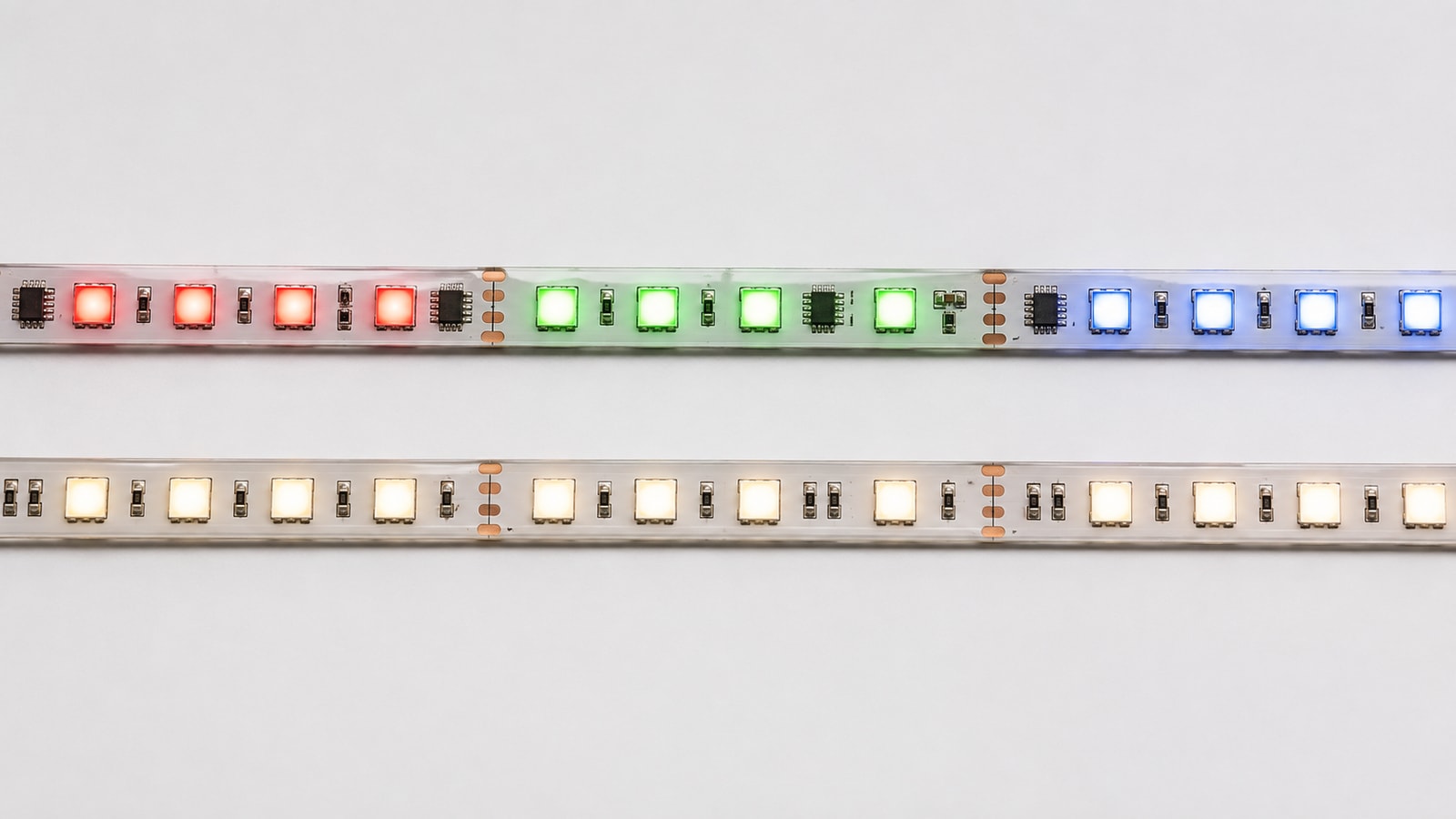
RGBIC and RGBW describe different parts of an LED strip system. RGBIC usually indicates that an integrated circuit controls multiple pixels or segments along the strip. RGBW indicates red, green, blue, and a dedicated white channel, but it does not say whether the strip is analog or addressable.
For outdoor Christmas lighting, the correct choice depends on the required animation, everyday white-light quality, pixel resolution, controller, voltage, maximum load, sealing, and installation plan. This guide helps OEM buyers, lighting brands, distributors, and project contractors compare those requirements before sampling.
Quick answer: RGBIC or RGBW?
Use the effect and white-light requirement as the first filters.
| Project requirement | Details |
|---|---|
| Several colors, chases or gradients along one run | Product direction to evaluate: Addressable RGB, often marketed as RGBIC Main limitation to confirm: White is normally mixed from RGB unless the exact pixel includes a white emitter |
| A whole zone changes color together and also needs usable white | Product direction to evaluate: Analog RGBW Main limitation to confirm: Every connected section in that controller zone follows the same channel command |
| Pixel effects and a dedicated white emitter | Product direction to evaluate: Addressable RGBW Main limitation to confirm: More control channels, controller capacity and power are required |
| Warm-to-cool white plus color | Product direction to evaluate: Addressable or analog RGB+CCT/RGBWW architecture Main limitation to confirm: Channel definition, CCT range, control protocol and power vary by model |
| Simple static Christmas color with no animation | Product direction to evaluate: Analog RGB, RGBW or separate single-color circuits Main limitation to confirm: Addressable control may add cost and commissioning work without adding value |
RGBIC is not automatically better than RGBW, and RGBW is not automatically a non-addressable product. The RFQ must define both the color channels and the control architecture.
Understand the terminology before comparing quotations
The market uses terms such as RGBIC, digital RGB, pixel strip, dream color, RGBICW, RGBWWIC, and addressable RGBW. These names are not a complete technical standard and may be arranged differently by different brands.
Ask every supplier to translate the marketing name into these fields:
- LED package and channel architecture: RGB, RGBW, RGB+CCT, or another combination;
- exact IC or supported pixel protocol;
- strip input voltage;
- LEDs per meter and controlled pixels per meter;
- number of LEDs controlled by one IC;
- color order and channel order;
- cut unit and data-flow direction;
- controller model, firmware and maximum mapped pixels;
- maximum current per output and connector; and
- outdoor body, lead, connector and end-seal construction.
Two products labelled RGBIC can use different voltages, protocols, pixel groupings and connectors. They are not interchangeable until those fields match.
How analog RGBW works
An analog constant-voltage RGBW strip normally has a common supply conductor and separate red, green, blue, and white channel conductors. The controller modulates the four channels, so all LEDs connected to the same output reproduce the same command at the same time.
This architecture is useful for:
- roofline zones that change as one color;
- facade accents divided into several separately controlled sections;
- warm-white everyday scenes with occasional holiday color;
- simpler commissioning without pixel mapping; and
- projects using compatible RGBW decoders or controllers.
The dedicated white channel can produce more useful white than mixing red, green, and blue, but its performance must still be specified. Ask for white-channel CCT, CRI, output, power, binning, tint consistency, and thermal behavior in the final waterproof construction.
Analog RGBW does not create independent colors at every point along one uninterrupted controller zone. More zones require separate controller outputs, decoders, or wiring branches.
How RGBIC or addressable RGB works
Addressable strip receives a digital data stream. Each pixel or controlled segment reads its assigned data and passes the remaining data along the chain. This allows different pixels to show different colors at the same time.
It is useful for:
- moving chases around rooflines;
- red, green, and white patterns displayed simultaneously;
- gradients and animated facade scenes;
- mapped holiday displays; and
- OEM products that need app, SPI, DMX-to-pixel, or custom-controller integration.
The data normally travels in one direction from DI to DO; some IC families add clock or backup-data conductors. The controller must support the exact protocol and signal timing. Strip supply voltage alone does not define data compatibility.
If one IC controls several LEDs, the whole group is one pixel. A strip marketed with 60 LEDs/m may therefore have far fewer than 60 independently controlled points per meter. Confirm both LED density and pixel density.
Addressable RGBW combines both requirements
Addressable RGBW uses digitally controlled pixels that include red, green, blue, and a dedicated white channel. It can deliver pixel effects and a specified white emitter, but it requires four control channels per pixel rather than three in a typical RGB pixel system.
This affects:
- controller channel or universe capacity;
- refresh rate for the mapped installation;
- data mapping and color order;
- maximum power under all-channel operation;
- power-feed and connector current; and
- commissioning time.
Do not infer the white CCT from the name RGBW. Some addressable RGBW strips use warm white, neutral white, or cool white; others use RGB plus dual-white channels. The model specification must identify the emitters.
Compare Christmas animation and everyday white light
Many outdoor projects need two different operating modes:
- animated color for Christmas, Halloween, events, or promotions; and
- restrained white light for normal evenings.
If animation is the main requirement and mixed RGB white is acceptable for occasional use, addressable RGB may be enough. If useful white light is part of the everyday lighting brief, evaluate RGBW or addressable RGBW and approve the white channel separately.
Mixed RGB white can vary with LED binning, current, diffuser, temperature, voltage drop, and channel calibration. It should not be presented as equivalent to a specified architectural white source. A dedicated white emitter is easier to define by CCT and CRI, but it still needs a real lit sample in the outdoor body and diffuser.
Choose pixel density from viewing distance and effect speed
Higher pixel density can create smoother motion and finer patterns, but it also increases controller data, power density, cost, and commissioning load.
Define:
- closest and normal viewing distance;
- total route length;
- the smallest desired moving feature;
- whether the strip is directly visible or reflected from a wall;
- diffuser or silicone-body depth;
- frame rate or effect-speed expectation; and
- total pixel count per controller output.
A concealed roofline wash may not need the same pixel density as a direct-view sign. Request a full-scale night test at the planned mounting distance before locking the pixel pitch.
Match the controller to the exact strip
Controller compatibility is a purchasing decision, not a commissioning detail to solve later.
For addressable products, confirm:
- IC/protocol name and timing;
- data-only or data-plus-clock wiring;
- data and backup-data arrangement if present;
- voltage and reference ground;
- RGB or RGBW channel count and color order;
- maximum mapped pixels per output;
- refresh-rate limits at the planned pixel count;
- signal distance and required differential receiver or amplifier;
- controller power-output current versus external power injection; and
- behavior after power loss or controller restart.
For analog RGBW, confirm supply voltage, common-anode or other wiring arrangement, PWM controller or decoder, per-channel current, total output current, dimming frequency, control protocol, and whether amplifiers are permitted.
Do not connect an addressable strip directly to an analog RGBW controller, or an analog RGBW strip to a pixel-data output.
Plan power for the most demanding approved scene
Color-changing strip does not draw the same power in every scene. A single-color chase may use much less power than all pixels at high output with multiple channels active.
Use the manufacturer’s maximum W/m or A/m for the exact product and operating mode. If the controller enforces a global brightness or power limit, record that limit as part of the approved system rather than assuming it will always be enabled.
Calculate each branch separately:
Branch power = maximum strip power per meter × branch length
Branch current = branch power ÷ strip voltage
Then check the driver, controller output, connector, cable, PCB, and injection points. Apply the power-supply manufacturer’s temperature and loading requirements. Do not select a driver by total wattage alone.
Understand voltage drop and color shift
Voltage drop can appear as lower brightness, changed white balance, incorrect colors, unstable pixels, or controller resets. Addressable pixels add logic that also needs adequate voltage, so visual symptoms may not be limited to dimming.
At equal power, a 24V strip draws half the current of a 12V strip, but the exact pixel design, cut unit and controller compatibility still matter. Power injection, both-end feeding, parallel branches, and distributed drivers must be designed from the product data and cable resistance.
Data and power should be reviewed separately. Supplying the correct voltage at a distant point does not guarantee that a single-ended pixel data signal remains valid over the same distance. Long signal routes may require a manufacturer-approved differential method or receiver.
Review the LED Strip Power Supply and Voltage Drop guide when preparing branch calculations.
Make every outdoor component part of the IP review
RGBIC and RGBW are color/control descriptions, not outdoor ratings. Confirm the ingress protection and construction of:
- strip body;
- input and output leads;
- data connector and power connector;
- field splice and injection point;
- cut end and end cap;
- controller or decoder;
- power supply and enclosure;
- cable glands; and
- mounting clips or channels.
An outdoor strip with an indoor controller is not a complete outdoor system. Field cuts and joins need the exact model’s approved sealing method. For direct rain or runoff, compare protected constructions in the Waterproof LED Strip Buying Guide.
Sample comparison plan
Compare RGBIC and RGBW samples under the same physical conditions.
| Sample test | What to record |
|---|---|
| White-light test | CCT, CRI if specified, tint, output and visual consistency from beginning to end |
| Color test | Red, green, blue, mixed colors, saturation and diffuser effect |
| Animation test | Pixel grouping, motion smoothness, update rate and controller stability |
| Full-load test | Input voltage, far-end voltage, branch current and component temperature |
| Restart test | Scene recovery, addressing, color order and behavior after power interruption |
| Outdoor assembly | Leads, joins, end caps, injection points, controller enclosure and mounting |
| Camera check | Visible banding or flicker under the project’s shutter and frame-rate conditions if filming is expected |
Use identical route length, diffuser, mounting position and supply conditions when comparing products. Otherwise, the test may compare two different installations rather than two control architectures.
RFQ checklist for RGBIC and RGBW outdoor projects
Include:
- Application, route drawing, total length and longest branch.
- Seasonal-only or year-round use.
- Desired effects and normal everyday scene.
- RGB, RGBW, addressable RGB, addressable RGBW, or RGB+CCT preference.
- Exact IC/protocol if already selected.
- LEDs/m, controlled pixels/m, grouping and cut unit.
- Voltage, maximum W/m, cable distances and injection plan.
- Controller, decoder, app, DMX, SPI or other interface requirement.
- White-channel CCT, CRI and output requirement.
- Outdoor exposure, IP target and field-sealing responsibility.
- Lead wire, connector, color order, data direction and labels.
- Quantity, target market, compliance documents, packaging and sample tests.
Review Wismart color-control product directions
Compare the RGB / RGBW SMD Strip, Addressable / Programmable SMD Strip, and Silicone Strip Lights product directions before choosing a Christmas-lighting sample.
Send the effect reference, white-light requirement, pixel density, route length, exposure, controller and order quantity through the RGBIC/RGBW project inquiry form. Wismart can identify the relevant specification-sheet route and prepare a comparable sample configuration.
Frequently asked questions
Does RGBIC always mean individually controlled LEDs?
No. It means the strip uses integrated-circuit control, but one IC may control one LED or a group of LEDs. Confirm controlled pixels per meter and LEDs per pixel.
Does RGBW always provide better white light?
It provides a dedicated white emitter, which is easier to specify than mixed RGB white. Actual quality still depends on CCT, CRI, output, binning, diffuser, thermal conditions and voltage consistency.
Can RGBIC also include a white channel?
Yes. Addressable RGBW and RGB plus dual-white products exist. Terms such as RGBICW or RGBWWIC are not universally standardized, so request the exact channel and IC definition.
Which system uses more power?
Power depends on LED density, channel architecture, brightness limits and operating scene. Addressable RGBW may have a higher maximum load than addressable RGB because it adds a white channel, but only the model datasheet can define the value.
Is 24V RGBIC always easier for long outdoor runs?
It can reduce current at equal power, but the IC design, pixel grouping, controller, cut unit, cable, connectors and injection plan still determine the practical result.
Conclusion
Choose RGBIC when independent color zones and animation are the priority. Choose RGBW when a whole zone can change together and a defined white channel is important. Evaluate addressable RGBW when the project needs both, then verify controller compatibility, pixel grouping, full-load power, voltage drop, outdoor sealing and sample performance before bulk ordering.