
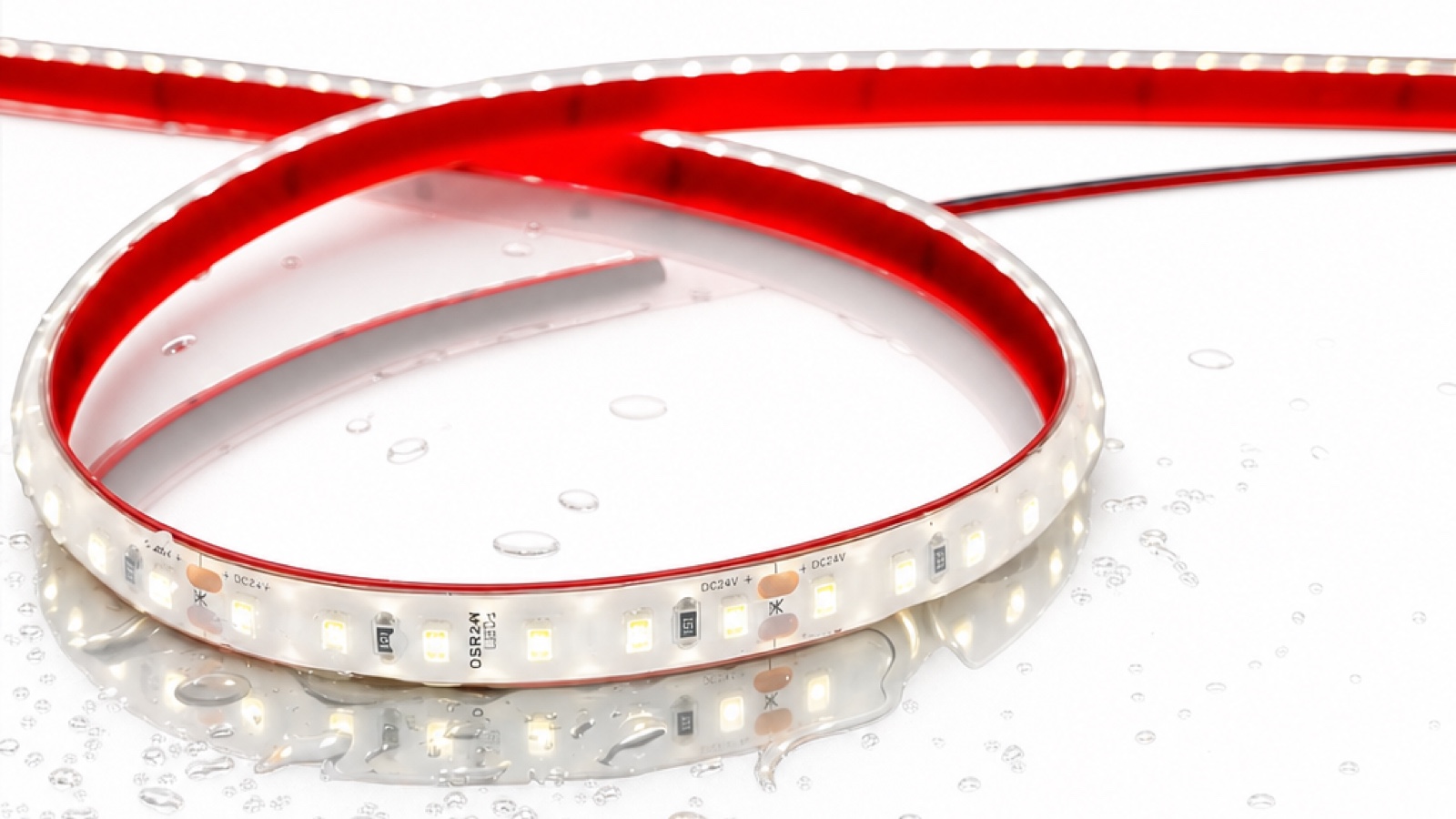
A request for “waterproof LED strip” is not complete enough for a professional quotation. A humid display, an outdoor sign, a facade joint, a wash-down area and an immersed fountain line create different water, chemical, mechanical and electrical risks.
This waterproof LED strip buying guide explains how B2B buyers should compare IP65, IP67 and IP68, then verify the complete strip assembly, end sealing, cable entry, connectors, mounting, driver location, environment and safety requirements before samples or RFQ approval.
Quick answer: IP65 vs IP67 vs IP68
| Exposure | Purchasing direction |
|---|---|
| Humidity, dust or controlled splash | Review IP65 or another suitable protected construction, then verify cut ends, cable entries and installation-zone requirements. |
| Direct weather or temporary immersion risk | Review an IP67-rated complete assembly and confirm the exact test scope, sealing, mounting, drainage and service conditions. |
| Continuous immersion | Request a dedicated IP68 system with manufacturer-defined immersion conditions. Confirm depth, duration, water type, cable system and electrical safety. |
| Water jets plus immersion | Ask for the appropriate dual or multiple rating. IP67 or IP68 alone does not automatically establish compliance with water-jet tests. |
| Chlorine, salt, UV, cleaning chemicals or pressure | Request separate material and system evidence. An IP code does not automatically cover these exposures. |
What the IP code actually tells a buyer
IEC 60529 classifies degrees of protection provided by enclosures. In an IP code, the first characteristic numeral addresses access and solid foreign objects; the second addresses harmful ingress of water under defined tests.
| Code element | Meaning in this comparison |
|---|---|
| First digit 6 | Dust-tight under the applicable test. |
| Second digit 5 | Protection against water jets under the specified test conditions. |
| Second digit 7 | Protection against the effects of temporary immersion under specified test conditions. |
| Second digit 8 | Protection for continuous immersion under conditions agreed or stated for the product and more severe than numeral 7. |
The code describes test performance of the rated enclosure or assembly. It does not, by itself, define the strip's silicone type, UV resistance, chemical resistance, allowable bending, electrical safety zone, warranty or installed lifetime.
IP rating and strip construction are separate decisions
Buyers often describe IP65 as a coating, IP67 as a tube and IP68 as potting. Those may be common market constructions, but they are not definitions of the IP code. Different manufacturers can use different materials and structures to achieve a rating.
| Decision | What to specify |
|---|---|
| Protection performance | Required IP code and the test/report scope for the exact model or complete assembly. |
| Physical construction | Coating, extrusion, sleeve, tube, encapsulation or integrated profile, including dimensions and materials. |
| Field handling | Whether cutting is allowed, approved end-sealing method, factory leads and connector restrictions. |
| Mechanical installation | Clips, channel, bend direction, minimum radius, expansion, joint spacing and service access. |
| Environment | UV, chemicals, salt, chlorine, cleaning, temperature, pressure, abrasion and water pooling. |
When to evaluate IP65 LED strip
An IP65 LED strip for humid or splash-prone areas can be a reasonable starting point when the product needs dust-tight protection and water-jet resistance under the rated test, but the installation does not require immersion performance.
- Protected kitchen or display details with a credible cleaning or splash risk.
- Bathroom or hospitality details outside restricted electrical zones, subject to local rules.
- Dusty indoor fixtures where a protected surface supports maintenance.
- Covered exterior details only when the real rain, drainage and wind exposure fit the complete product specification.
Do not select IP65 only because it is thinner or cheaper than a tube. Verify that all cut ends, leads, connectors and joints retain the required protection. Condensation, standing water, aggressive cleaning and direct weather can exceed the intended condition even when the strip body has an IP65 label.
When to evaluate IP67 LED strip
An IP67 LED strip for outdoor signage or facade lighting is a stronger starting point when direct weather or temporary immersion risk is credible. The rating still applies only to the tested enclosure or assembly and does not make every field-cut installation automatically IP67.
- Outdoor signage and storefront lines exposed to rain.
- Facade edges and architectural details with controlled drainage.
- Landscape accents protected from mechanical damage and prolonged submersion.
- Exterior projects where factory-sealed leads and defined mounting accessories can be used.
For quotation, request the exact IP evidence, cross-section drawing, cut/seal instructions, cable-exit options, connector limitations, clip/channel system, UV and temperature information, model-level power/run data and warranty conditions.
When IP68 needs a dedicated system review
IP68 is not a universal promise of unlimited depth or time. The immersion conditions must be defined for the product, and the complete cable and sealing system must match those conditions. Continuous immersion also introduces project risks that the IP code does not fully describe.
| IP68 RFQ question | Why it is required |
|---|---|
| Depth and pressure | Hydrostatic conditions change with depth and may exceed the tested product condition. |
| Duration and operating state | Continuous installed service, temporary testing and operation while immersed are different conditions. |
| Water chemistry | Fresh water, chlorinated pool water, salt water and cleaning chemicals can affect seals and materials differently. |
| Cable and junction system | Water can enter through leads, splices or remote joints even when the luminous body is sealed. |
| Electrical location rules | Pools, fountains and similar zones require project-specific voltage, isolation, protection and qualified installation. |
A dedicated underwater luminaire may be more appropriate than flexible strip. Do not treat a generic IP68 claim as approval for a pool, fountain or marine installation.
IP67 or IP68 alone may not cover water jets
IEC 60529 distinguishes jet tests from immersion tests. An enclosure marked only for numeral 7 or 8 does not automatically have to pass numeral 5 or 6 water-jet tests. When the project involves both cleaning jets and immersion, ask for the applicable dual or multiple designation and test evidence.
This matters in wash-down details, pools that are cleaned with jets, food-service areas and outdoor installations exposed to pressurized cleaning. The word “higher” in IP68 should not be interpreted as “covers every lower water exposure.”
The installed system is only as protected as its weakest point
| System point | Approval requirement |
|---|---|
| Cut end and end cap | Use the approved factory or field method, sealant, cure process and workmanship inspection. |
| Cable entry | Confirm entry direction, strain relief, sealing, bend and water-tracking risk. |
| Connector or splice | Use a component rated and installed for the required environment; do not assume a quick connector matches the strip body. |
| Driver and controller | Locate in a suitable dry/protected area or select each item for its own environment. |
| Mounting and drainage | Avoid water traps, abrasion, unsupported movement and bend/twist outside product limits. |
| Field modification | Confirm whether cutting, soldering or changing leads affects the product rating and warranty. |
A component-level rating should not be extended to an entire installation without evidence. Record the exact strip, end treatment, leads, joints, mounting and driver enclosure used in the approved sample.
Check UV, chemicals, temperature and mechanical exposure separately
The IP code focuses on ingress under defined tests. It does not automatically establish resistance to sunlight, yellowing, chlorine, salt mist, oils, cleaning agents, high-pressure cleaning, thermal cycling, abrasion, impact or prolonged flexing.
- Request UV or weathering information for exterior exposure.
- Identify all chemicals and cleaning procedures before choosing the silicone or encapsulation material.
- Confirm operating and storage temperatures for the strip, sealant, cable and driver.
- Use clips or channels where adhesive alone cannot provide reliable long-term fixing.
- Protect the product from foot traffic, sharp edges, crushing and uncontrolled movement.
Application-based waterproof strip selection
| Application | Questions before choosing the IP route |
|---|---|
| Bathroom mirror or hospitality detail | Electrical zone, splash/condensation risk, profile, ventilation, cleaning and service access. |
| Kitchen or retail fixture | Cleaning jets versus wipes, chemicals, heat, cut ends and food/fixture requirements. |
| Outdoor sign | Direct rain, drainage, sealed leads, connector location, UV, wind and driver enclosure. |
| Facade contour | Exposure, cable entry, expansion, bend direction, clips/channel, drainage and maintenance route. |
| Landscape or deck edge | Water pooling, irrigation, soil/chemicals, mechanical protection and seasonal temperature. |
| Pool or fountain | Dedicated product availability, depth, chemistry, zones, isolation, protection devices and qualified design. |
Build a representative waterproof sample
A short glowing strip body does not test the failure points of a wet installation. The sample should reproduce the planned factory lead or connector, end cap, cable exit, mounting accessory, bend and critical environmental condition.
| Sample check | What to verify |
|---|---|
| Provenance | Exact model, construction, IP evidence and production sealing method. |
| Mechanical fit | Cross-section, bend direction/radius, clips, channel, expansion and service access. |
| Seal details | End caps, leads, joints and cure/workmanship using the production method. |
| Exposure test | Use a qualified test appropriate to the claimed rating and project condition; do not improvise unsafe mains-connected water tests. |
| Thermal behavior | Operate in the intended mounting and ambient condition and compare with model limits. |
| Optical result | Check brightness, CCT/color appearance, beam, uniformity and any change caused by the protective material. |
RFQ checklist for IP65, IP67 and IP68 LED strip
| RFQ input | Information to send |
|---|---|
| Exposure | Humidity, splash, jets, rain, pooling, temporary or continuous immersion. |
| Environment | Indoor/outdoor, UV, water chemistry, cleaning agents, temperature, salt, abrasion and mechanical risk. |
| Protection target | Required IP code, dual rating if needed, test/report request and complete-assembly scope. |
| Strip specification | Voltage, watts/output, CCT, CRI/color control, dimensions, cut length and total quantity. |
| Sealing and cable | Factory-cut lengths, end caps, lead length, cable-exit direction, joints and connector plan. |
| Mounting | Drawing, bend direction/radius, clips/channel, drainage, expansion and maintenance access. |
| Electrical system | Driver/controller location, environment, feeds, protection and local qualified-installation requirements. |
| Commercial scope | Sample plan, destination market, compliance documents, labels, packaging and warranty conditions. |
Review Wismart protected-strip options
Use Wismart's Silicone Strip Lights category to compare encapsulated, IP67 tube, integrated linear and outdoor-protected project routes. The IP67 Silicone Tube Strip page is the current Wismart starting route for outdoor-ready protected structure discussions, including 12V/24V direction, sealing, cable entry and mounting review.
Wismart's public IP67 route is not an automatic offer of an IP68 immersion product. For continuous immersion, send the exact depth, duration, water chemistry, cable/junction design and safety requirements so availability and product suitability can be reviewed rather than assumed.
Download the Wismart Silicone / Neon Catalog, review the full Product Center, and submit the drawing and exposure details through the waterproof-strip sample and quotation form.
Frequently asked questions
Is IP68 always better than IP67?
No. IP68 addresses continuous immersion under defined product conditions. It can add size, cost and installation restrictions, and it does not automatically cover water jets, chemicals or every outdoor exposure. Choose the rating that matches the real environment and complete system.
Can an IP67 strip be cut on site and remain IP67?
Only if the exact product permits field cutting and the approved sealing process restores the required performance. Factory-sealed lengths may be the safer route for critical exterior projects. Confirm the manufacturer's instructions and warranty conditions.
Does IP67 include UV and salt resistance?
No. UV, salt, chlorine and chemical resistance are separate material or product qualifications. Request the evidence that matches the intended exposure.
Does an IP-rated strip make the complete installation waterproof?
No. End caps, cable entries, connectors, drivers, controllers, junctions, mounting and workmanship determine the installed result. The complete system must be reviewed and tested for the project condition.
Conclusion
Choose IP65, IP67 or IP68 from the real exposure and verified test scope, then specify the physical construction and complete installation separately. Do not infer unlimited immersion, water-jet resistance, chemical resistance or system-level protection from one IP number.
Review Wismart Silicone Strip Lights and the IP67 Silicone Tube Strip, download the current catalog, and request a matched datasheet, sample and quotation with the full exposure, sealing, mounting and electrical details.