
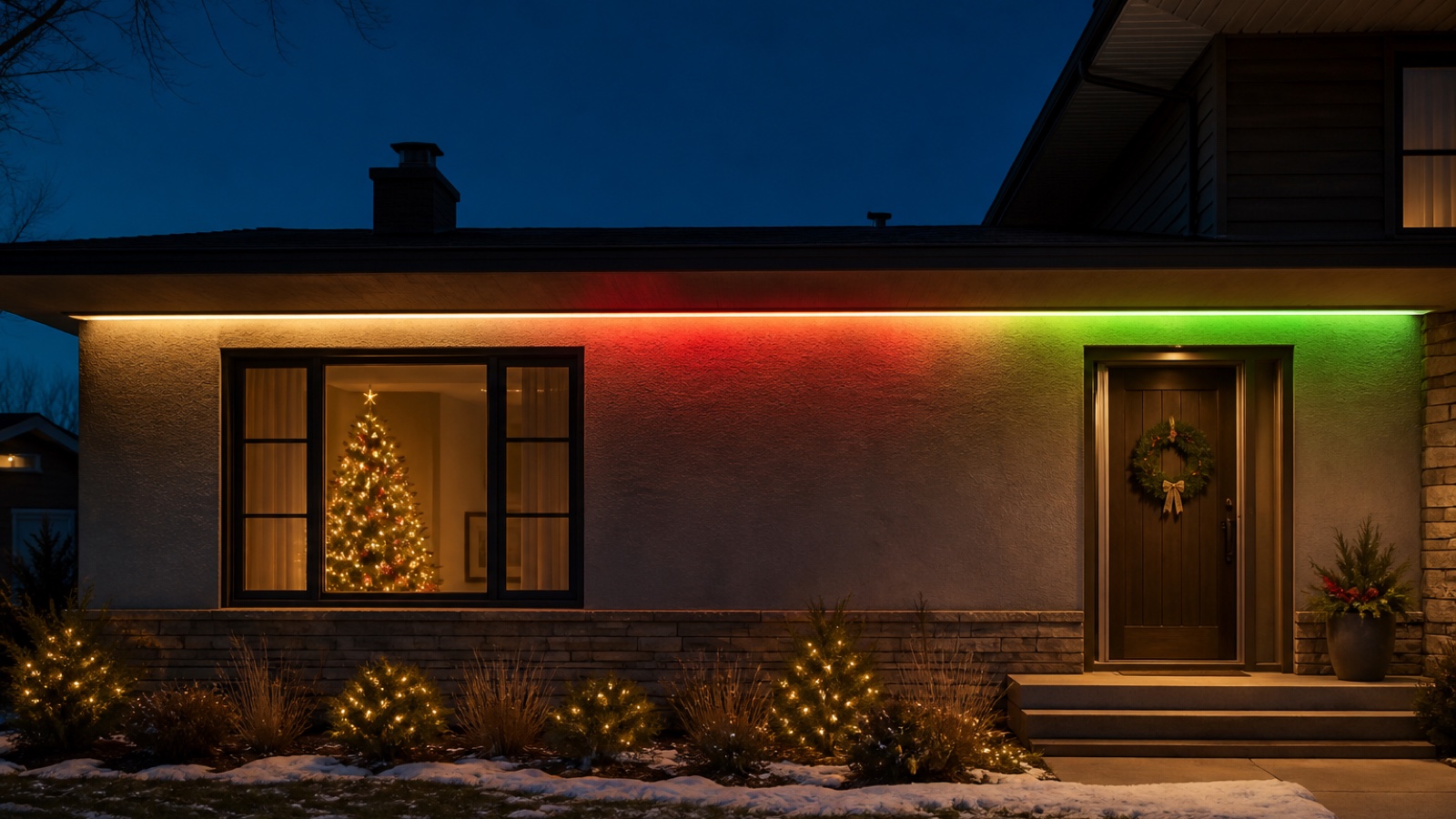
Outdoor LED strip lights are not simply indoor tape with a waterproof label. A reliable outdoor system has to match the exposure, visible light effect, run length, voltage, control method, mounting surface, cable exits, connectors, power supply, and maintenance plan.
For distributors, lighting brands, contractors, and project buyers, the purchasing decision should begin with the installation drawing and environmental conditions. The strip, controller, power supply, wiring, seals, and mounting hardware should then be approved as one system.
Quick answer: which outdoor LED strip should buyers choose?
Use the required light effect and exposure level as the first filters.
| Outdoor application | Product direction to evaluate | Main purchasing checks |
|---|---|---|
| Covered patio, deck, or handrail accent | Protected SMD or COB strip in a compatible profile | Splash exposure, voltage, output, profile fit, cable route, and mechanical fixing |
| Exposed facade or building edge | IP67 silicone tube strip or outdoor Neon Flex | Direct rain, drainage, UV exposure, bend direction, end sealing, clips, and service access |
| Visible continuous contour line | Top-bend or side-bend Neon Flex | Viewing direction, minimum bend radius, cross-section, cut unit, mounting clips, and color consistency |
| Landscape detail or pathway edge | Protected strip or silicone linear product designed for the location | Standing water risk, impact, soil or chemical exposure, driver location, and replaceability |
| Outdoor sign or retail display | RGB/RGBW strip, addressable strip, or Neon Flex | Required effect, white-light quality, control protocol, pixel grouping, IP structure, and sample approval |
| Christmas and seasonal display | RGBW, RGBIC/addressable strip, or outdoor Neon Flex | Dynamic effect, dedicated white channel, weather protection, controller, long-run power plan, and reusable mounting |
An IP number alone does not select the product. Two IP67 products may use different tube walls, end caps, cable exits, bending limits, thermal paths, and installation accessories. Buyers should approve the exact construction they intend to order.
Start with the light effect: concealed strip or visible line?
Outdoor projects normally use one of three physical product routes.
Protected flexible LED strip
Use a protected SMD or COB strip when the light source is concealed under a ledge, inside a compatible profile, behind a handrail, or within another architectural detail. This route is useful when the project needs indirect light, compact dimensions, or a replaceable strip inside a profile.
The waterproof material changes the strip dimensions and may affect heat dissipation, connector fit, optical output, and cut handling. Confirm the finished protected width and height rather than using the bare PCB dimensions.
Outdoor COB strip
COB can produce a smoother line at short viewing distances, but the COB label does not establish outdoor suitability. Buyers still need a model-specific protected structure, approved sealing method, thermal plan, and compatible mounting profile. Do not place an indoor COB strip outside because its light line appears continuous.
LED Neon Flex
Use Neon Flex when the illuminated line itself is visible and the project needs a more finished direct-view appearance. It is often the stronger route for facade contours, signs, window outlines, decorative motifs, and seasonal installations.
Top-bend and side-bend products curve in different planes. The route drawing must show the required bending plane, corners, feed direction, and cable exit before the cross-section is selected. Neon Flex should not be twisted or forced below the model's specified bend radius.
IP65 vs IP67 vs IP68: choose by real exposure
The IP rating describes tested ingress protection for a defined product construction. It does not describe every outdoor risk and does not automatically apply to field-made joints or accessories.
| Exposure condition | Starting point | What still needs confirmation |
|---|---|---|
| Covered outdoor area with occasional splash | IP65 may be considered | Wind-driven rain, cleaning method, orientation, cable exit, and connector protection |
| Direct rain or short-duration water exposure | IP67 construction is usually the stronger starting point | End caps, factory leads, drainage, mounting, temperature, and exact test report |
| Continuous immersion requirement | Only a purpose-designed IP68 system with defined conditions | Water depth, duration, water chemistry, temperature, cable entry, driver isolation, and local safety requirements |
Do not treat IP68 as permission for unlimited depth, time, temperature, or chemical exposure. The manufacturer must define the tested conditions and product boundary.
The complete installation also includes components that may have different protection levels:
- strip or Neon Flex body;
- factory lead and cable exit;
- end cap and field-cut seal;
- connector or splice;
- controller or decoder;
- power supply or adapter;
- junction box, cable gland, and mains connection.
A waterproof strip connected to an unprotected controller or poorly sealed field joint is not a waterproof lighting system.
For a detailed comparison, review the Waterproof LED Strip Buying Guide: IP65 vs IP67 vs IP68.
Choose the color architecture for the real use case
Outdoor LED strip buyers should decide whether the product is mainly for illumination, decorative color, dynamic effects, or a combination.
Fixed white
Use fixed-white strip when the project needs a consistent architectural line, pathway accent, handrail light, or warm exterior detail. Specify CCT, CRI, output, power per meter, binning requirement, and dimming method. The waterproof cover or profile diffuser can change the final appearance, so approve the assembled sample.
Tunable white
Tunable-white strip is useful when the project needs warmer evening scenes and cooler task or event settings. Confirm the CCT range, channel balance, controller, dimming curve, and maximum load in each operating mode.
RGB and RGBW
Analog RGB is appropriate when the entire connected zone can change together. RGBW adds a dedicated white channel and is generally the better starting point when the same installation must provide both colored effects and usable white light.
The presence of a white channel does not prove its CCT, CRI, tint consistency, or output. Request model-level data and a lit sample.
RGBIC or addressable strip
Addressable outdoor LED strip supports multiple colors or effects along one run. It can be suitable for facade animation, entertainment areas, retail displays, and Christmas installations. However, RGBIC, addressable, and programmable are category terms rather than complete specifications.
Before ordering, confirm:
- exact IC or supported protocol;
- strip voltage;
- LEDs per meter and controlled pixels per meter;
- LEDs controlled by each pixel;
- cut unit and data direction;
- RGB or RGBW channel architecture;
- controller model, firmware, color order, and pixel capacity;
- signal distance and any required signal conditioning;
- maximum electrical load and power-feed plan; and
- exact outdoor protection structure.
Review the RGBIC LED Strip Buying Guide before comparing addressable samples.
12V vs 24V outdoor LED strip
Both 12V and 24V products can be used in outdoor systems when the exact strip and accessories are designed for the application. Voltage affects current, cut interval, cable size, control equipment, feed locations, and voltage drop.
At equal power, a 24V system draws half the current of a 12V system. This can make power distribution easier on longer runs, but it does not eliminate voltage drop or create a universal maximum run length.
| Decision factor | 12V may suit | 24V may suit |
|---|---|---|
| Run layout | Short sections and small local features | Longer distributed lines and larger commercial zones |
| Cut requirement | Projects needing a model with shorter cut units | Projects that can accept the selected 24V cut interval |
| Existing system | Installations already standardized on 12V | Projects designed around 24V drivers and controls |
| Current and cable planning | Lower-power short runs | Higher total power or longer feeder distances where reduced current helps |
| Addressable control | Models whose IC architecture is designed for 12V | Models whose IC architecture is designed for 24V, often with model-specific pixel grouping |
Do not choose voltage from a generic rule. Ask for the longest powered run, total watts per meter, feed-wire distance, allowable brightness variation, cut unit, and controller architecture.
Plan the power supply and voltage drop before quotation
Outdoor strip failures are often system failures rather than LED failures. Long cables, undersized connectors, excessive current through one feed, hot enclosures, and poorly located drivers can create dim ends, color shift, unstable control, or early component failure.
Use this process:
- Obtain the maximum W/m and A/m for the exact strip and operating mode.
- Record total installed length and the longest individually powered run.
- Match the strip to the correct constant-voltage power supply.
- Apply the power-supply manufacturer's loading and temperature-derating requirements.
- Calculate voltage drop through the complete loop, including feed cable, connectors, controller, PCB, and return path.
- Divide the project into appropriate power branches and protection zones.
- Measure input and far-end voltage under the most demanding approved scene.
- Confirm brightness and color consistency at representative installation temperature.
Power injection, both-end feeding, parallel branches, and additional drivers are project-specific methods. There is no universal instruction such as injecting power every fixed number of meters.
The driver should be installed in a location that matches its own environmental rating and thermal requirements. A waterproof enclosure can also trap heat, so enclosure selection, ventilation strategy, cable glands, drainage, and service access need review.
For calculation and testing guidance, see How to Choose LED Strip Power Supply and Avoid Voltage Drop.
Mounting outdoors: adhesive is not the complete fixing plan
Outdoor surfaces experience temperature cycling, moisture, dust, UV exposure, expansion, contraction, and wind. Adhesive performance also depends on the substrate, surface preparation, strip weight, installation orientation, and waterproof jacket.
Use the mounting method approved for the exact product:
- compatible clips at the specified spacing;
- aluminum profile with suitable dimensions and drainage;
- screw-fixed channel or carrier;
- factory mounting track for a dedicated system; or
- adhesive as a positioning aid where the manufacturer permits it, supported by mechanical fixing when required.
Do not screw through the strip body or silicone jacket. Do not use cable ties that crush the product or force sharp bends. Avoid unsupported spans, water traps, and routes that place the cable exit under continuous tension.
For direct-view Neon Flex, align clips so the product bends only in its designed plane. Corners that cannot be achieved within the bend radius should use a planned joint, molded corner, or separate factory-prepared section.
Cutting, connectors and field sealing
Not every outdoor LED strip is field-cuttable. Some finished kits prohibit cutting or extension; other project-grade strips can be cut only at marked intervals and then resealed with an approved process.
Before ordering, ask:
- Is field cutting allowed?
- What is the electrical cut interval?
- Does the waterproof cut point differ from the PCB cut point?
- Which end cap, adhesive, sealant, and curing process are approved?
- Can the supplier provide factory-cut and factory-sealed lengths?
- What cable exit directions and lead lengths are available?
- Is the connector rated for the actual current and environment?
For repeat projects, factory-prepared lengths can reduce variation in field sealing. The sample must use the same end cap, cable, sealant, connector, and workmanship planned for production.
Environmental and compliance checks
An IP rating does not cover every outdoor condition. Include the following in the RFQ when relevant:
- minimum and maximum ambient temperature;
- direct sunlight and UV exposure;
- salt air or coastal installation;
- chlorine, cleaning chemicals, fertilizer, or pool chemicals;
- snow, ice, standing water, or freeze-thaw cycles;
- impact, abrasion, foot traffic, or landscaping equipment;
- continuous operating hours and maintenance access; and
- target-market electrical, EMC, material, and safety documentation.
Certifications and test reports must be matched to the exact model, power supply, controller, and target market. A certificate from another product family should not be used to approve the proposed outdoor system.
Sample test plan for outdoor LED strip lights
A short illuminated sample proves only that the LEDs turn on. A useful project sample should reproduce the production construction and the most demanding installation condition.
| Sample check | What to verify |
|---|---|
| Structure | Finished width and height, tube or coating consistency, cut marks, end caps, cable exit, and connector |
| Light effect | Brightness, CCT or color, visible dots, diffuser appearance, and first-to-last-meter consistency |
| Electrical performance | Maximum load, input voltage, far-end voltage, controller current, and driver temperature |
| Control | Dimming range, RGB/RGBW behavior, addressable pixel map, firmware, effects, and camera behavior if relevant |
| Installation | Profile or clip fit, bend direction, bend radius, corners, drainage, lead routing, and service access |
| Environmental exposure | The project-specific splash, rain, immersion, temperature, UV, or chemical test defined by the buyer |
| Sealing | Factory lead, field joint, end cap, cable gland, and enclosure protection |
Do not approve a waterproof construction from appearance alone. Request the applicable test report and test the final sample assembly under the intended conditions.
RFQ checklist for commercial outdoor LED strip projects
Send the following information before requesting a final datasheet, sample, or quotation:
| RFQ item | Information to provide |
|---|---|
| Application | Facade, eave, patio, deck, handrail, landscape, sign, retail display, or seasonal installation |
| Exposure | Covered, direct rain, water jets, standing water, temporary immersion, or continuous immersion |
| Light effect | Concealed glow, visible continuous line, white illumination, RGB zone color, or addressable animation |
| Product family | SMD, COB, RGB/RGBW, addressable strip, Neon Flex, or silicone linear strip |
| Electrical data | Voltage, W/m, total length, longest run, feeder distance, driver location, and control method |
| Optical data | CCT, CRI, color channels, brightness target, pixel density, and diffuser or profile |
| Construction | IP target, finished dimensions, cut unit, bend direction, cable exit, lead length, connector, and mounting |
| Environment | Temperature range, UV, coastal air, chemicals, impact, and operating schedule |
| Target market | Required model-level certificates, labels, plug, packaging, warranty, and documentation |
| Sample request | Exact length, accessories, controller, power supply, sealing method, test condition, and approval criteria |
Review outdoor LED strip options with Wismart
Wismart supports several product routes that can be evaluated for outdoor linear-lighting projects:
- Silicone Strip Lights for protected strip structures;
- IP67 Silicone Tube Strip for exposed protected-line discussions;
- Neon Flex for visible contours, signs, facade lines, and decorative shapes;
- Addressable / Programmable SMD for model-level RGBIC control architecture review; and
- the LED Strip Product Center for COB, SMD, Neon Flex, and silicone product-family comparison.
Outdoor protection and addressable control must be confirmed on the same exact model. Do not assume that every addressable strip is outdoor-rated or that every silicone strip supports the required IC and controller.
To request a datasheet direction, project sample, or quotation, send the application drawing, exposure, voltage, run lengths, color or control requirement, IP target, cable exit, mounting method, quantity, and target market through the Wismart outdoor LED strip inquiry form.
Frequently asked questions
Can any LED strip light be used outdoors?
No. The exact strip construction, factory leads, joints, controller, power supply, mounting method, and installation environment must be approved for outdoor use.
Is IP65 enough for outdoor LED strip lights?
It may be suitable for some covered or splash-prone locations, but it should not be treated as a universal outdoor rating. Direct rain, standing water, cleaning methods, orientation, and field joints can require a different construction.
Are 24V outdoor LED strip lights always better than 12V?
No. A 24V system can reduce current at equal power and may simplify longer runs, but the correct choice also depends on cut interval, strip circuit, controller, cable distance, voltage drop, and the required product family.
Should buyers choose RGB, RGBW or RGBIC for outdoor decoration?
Choose RGB when each connected zone can change together, RGBW when a dedicated white channel is needed, and RGBIC/addressable strip when the project requires multiple colors or moving effects along one run. Verify white-light data and controller compatibility separately.
Can outdoor LED strip lights rely on adhesive tape?
Adhesive may assist positioning on a compatible prepared surface, but exposed or permanent projects often require approved clips, channels, or other mechanical support. Follow the exact product installation method.
Can waterproof LED strip lights be cut on site?
Only when the exact model permits it. Cutting can open the waterproof construction, so the cut end must be resealed with the approved components and process. Factory-cut and factory-sealed lengths may be safer for repeat projects.