
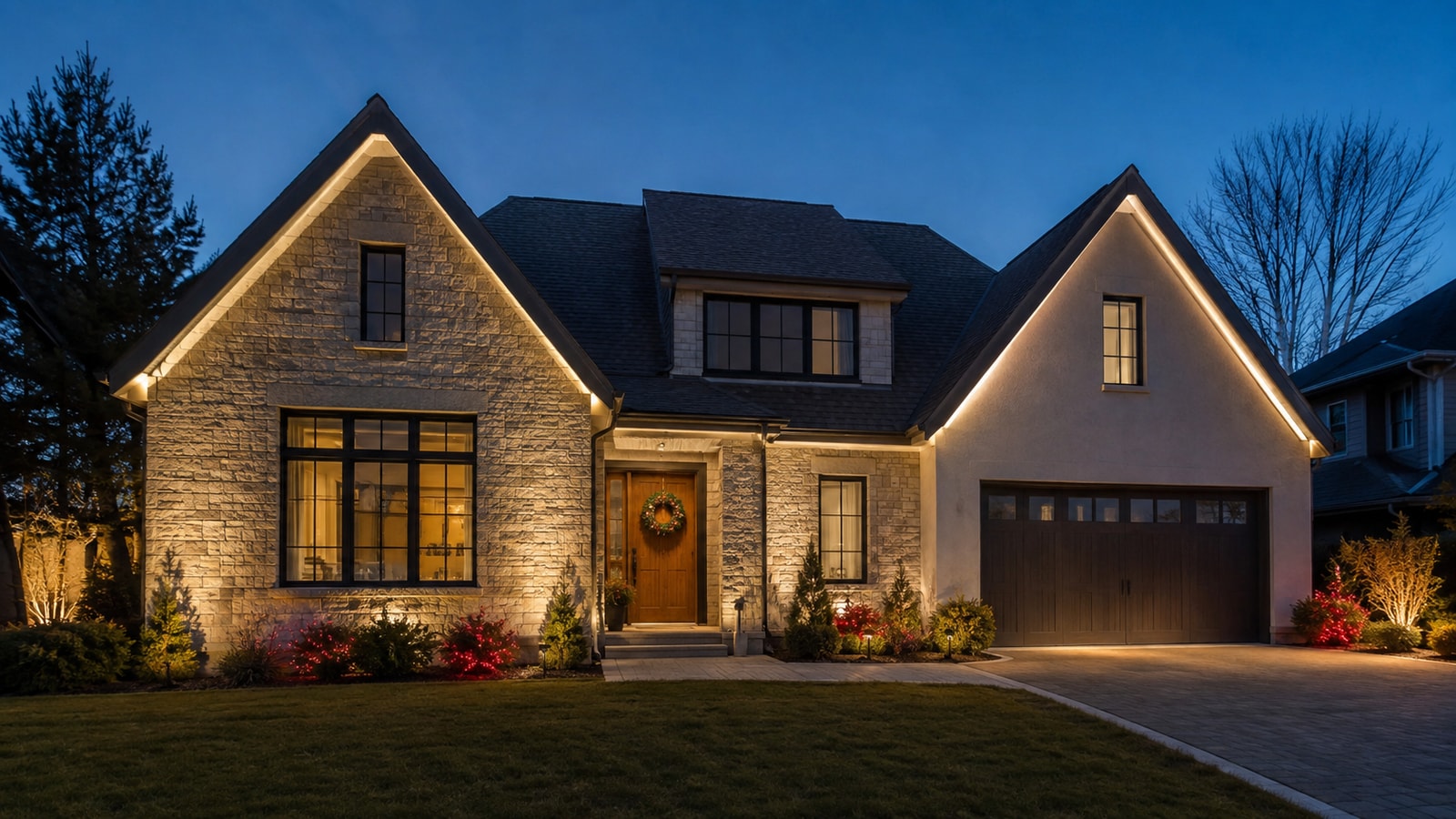
LED strip lights can create a clean line under eaves, a concealed wash across a facade, or programmable color effects along a roofline. The correct product, however, depends on more than the word “outdoor.” Buyers need to match the required visual effect with the strip structure, exposure, mounting detail, voltage, controller, cable route, sealing method, and maintenance plan.
This guide is written for lighting brands, distributors, contractors, holiday-display suppliers, and project buyers comparing LED strip solutions for Christmas and year-round exterior installations.
Quick answer: which product route fits the roofline effect?
Start with the appearance the project needs, then confirm whether flexible strip is the right physical product.
| Required result | Details |
|---|---|
| Concealed warm-white or colored wash under an eave | Product route to evaluate: Protected SMD or COB strip inside a compatible channel Main purchasing checks: CCT or color, output, profile dimensions, IP construction, voltage drop, mounting and service access |
| A visible continuous luminous line around a building edge | Product route to evaluate: Outdoor LED Neon Flex Main purchasing checks: Top-bend or side-bend direction, cross-section, bend radius, cut unit, end caps, clips and viewing distance |
| Multiple colors or moving effects along one line | Product route to evaluate: Outdoor addressable/RGBIC strip or addressable Neon Flex Main purchasing checks: IC protocol, controlled pixels per meter, RGB or RGBW architecture, controller capacity, data direction and power injection |
| Colored scenes plus useful white light | Product route to evaluate: RGBW or addressable RGBW product Main purchasing checks: White-channel CCT, CRI, output, channel current, controller and color consistency |
| Distinct pools or triangular patterns on the wall below the eave | Product route to evaluate: A purpose-designed point-light or permanent eave-light system Main purchasing checks: Pixel spacing, optic, mounting distance and system-specific controller; ordinary strip will not reproduce the same pattern |
| Temporary seasonal decoration that will be removed | Product route to evaluate: Outdoor-rated strip or Neon Flex with reusable mounting Main purchasing checks: Removal method, storage radius, connectors, labels and replacement sections |
Do not select from a lifestyle photograph alone. Two products can produce very different wall patterns even when both are sold for roofline lighting.
LED strip is not the same as a permanent outdoor point-light system
Search results for permanent Christmas lights often show individual light heads installed at fixed spacing under a soffit. Each head throws a separate pool of light onto the wall. That construction is not an LED strip, even when the lights are connected by a flexible cable and controlled in segments.
Flexible LED strip normally creates a continuous or closely spaced line of light. When concealed behind a fascia or inside a profile, it produces a wash rather than separate cones. LED Neon Flex adds a diffused silicone body for a more finished direct-view line. Addressable strip can create moving colors along the route, but its optical appearance still depends on LED pitch, diffuser depth, mounting position, and viewing surface.
Buyers should therefore specify the desired wall effect, not simply request “permanent outdoor lights.” If the reference image shows separated pools of light, a point-light system may be the correct category. If it shows a continuous linear glow, strip or Neon Flex is more relevant.
Begin with an eave and roofline drawing
A useful supplier review starts with a marked drawing or clear site photographs. Record:
- the measured centerline route for each elevation;
- straight sections, inside corners, outside corners and changes of plane;
- concealed or direct-view sections;
- the distance from the light to the wall or reflecting surface;
- power-supply and controller locations;
- low-voltage cable distances;
- factory lead and cable-exit directions;
- areas exposed to rain, runoff, snow, ice or cleaning water; and
- access points for inspection and replacement.
Do not force a flexible product around a corner that requires a change in bending plane. A flat strip, top-bend Neon Flex and side-bend Neon Flex follow different routes. Corners may require a cable jumper, factory-molded lead, connector, or separate section rather than a sharp fold.
Decide whether the installation is seasonal or year-round
Christmas installations and permanent architectural installations can use similar light effects, but their purchasing priorities differ.
Seasonal installation
A removable system needs repeatable mounting, labelled sections, protected connectors, controlled storage, and a plan for testing before each installation. Adhesive-only mounting is difficult to reuse and may damage the strip or surface during removal. Clips, channels, or purpose-made holders are usually easier to document and replace.
Confirm how the product will be coiled after removal. The storage reel and carton must respect the product’s minimum bend radius and prevent twisting, crushing, and moisture entrapment.
Year-round installation
A year-round system needs closer review of UV exposure, temperature range, wind, rain path, snow or ice load around the mounting detail, cable aging, drainage, corrosion risk, and service access. The buyer should approve the exact outdoor construction and accessories, not an indoor sample from the same LED family.
“Permanent” should mean that the complete installed system was designed for the stated environment and maintenance plan. It should not mean that the product can never be inspected or replaced.
Choose the optical effect before the LED package
The mounting position often determines whether COB, SMD, Neon Flex, or a point-light system is appropriate.
Concealed eave wash
Protected SMD or COB strip can work when the strip is hidden and the building surface receives the light. COB may provide a smoother source at short distance, while SMD offers a wide range of output, color and control configurations. The final uniformity depends on LED pitch, profile depth, diffuser, setback, surface texture, and viewing distance.
Direct-view roofline
When users see the luminous line itself, outdoor Neon Flex is often the stronger starting point. Confirm the required bend plane and cross-section before choosing top-bend or side-bend construction. Review the Top Bend vs Side Bend LED Neon Flex guide when the route changes direction around signage or facade details.
Animated color line
Addressable strip supports different colors along the same run. The words RGBIC, pixel, digital, and programmable do not define the electrical system. The RFQ still needs the IC or protocol, strip voltage, LED and pixel density, grouping, color order, data direction, controller, maximum pixels per output, and power-feed plan.
Select outdoor protection for the whole system
IEC 60529 classifies ingress protection for an enclosure or product construction under defined tests. An IP code is not a general guarantee against every outdoor condition.
For roofline projects, review the exposure at every component:
- strip or Neon Flex body;
- factory lead and cable exit;
- cut end and end cap;
- field connector or splice;
- controller or decoder;
- power supply;
- junction box and cable gland; and
- mounting channel, clips and drainage path.
An IP67 strip does not make an IP20 controller suitable for outdoor exposure. The weakest exposed component can determine the practical protection of the installed system. Likewise, a profile can improve mounting and appearance without becoming a sealed enclosure.
For direct rain or runoff, a silicone tube, encapsulated strip, or outdoor Neon Flex may be a better starting point than a lightly coated strip. IP68 should only be specified when the manufacturer defines the immersion conditions; it does not mean unlimited depth, duration, temperature, or water chemistry. Compare the protection routes in the Waterproof LED Strip Buying Guide.
RGB, RGBW or RGBIC for Christmas and everyday scenes?
Choose the color architecture from the required scenes.
| Color system | Details |
|---|---|
| Fixed white | Best fit: Consistent architectural accent and warm roofline glow Limitation to confirm: One CCT unless separate circuits or tunable-white strip are used |
| Analog RGB | Best fit: Whole-zone color changes Limitation to confirm: Mixed RGB white is not a substitute for a specified white channel |
| Analog RGBW | Best fit: Whole-zone color plus a dedicated white channel Limitation to confirm: Every section in the zone follows the same channel command |
| Addressable RGB/RGBIC | Best fit: Chases, gradients and multiple simultaneous colors Limitation to confirm: White is normally mixed from RGB unless the exact pixel includes white |
| Addressable RGBW | Best fit: Pixel effects plus a dedicated white emitter Limitation to confirm: More channels, controller capacity and power planning are required |
If the project uses warm white most evenings and animated color only during holidays, a dedicated white channel is usually worth evaluating. The buyer should still specify its CCT, CRI, output and binning; RGBW alone does not define white-light quality.
For addressable products, confirm whether one IC controls one LED, several LEDs, or a longer segment. That grouping determines effect resolution and cut behavior. Review the RGBIC LED Strip Buying Guide before approving controllers and samples.
Choose 12V or 24V from the electrical layout
At equal power, a 24V load draws half the current of a 12V load. This can simplify current distribution on longer roofline branches, but 24V does not eliminate voltage drop or guarantee a longer maximum run.
Use 12V when the selected product, cut interval, controller, or existing system requires it and the branch lengths are practical. Evaluate 24V when longer distributed runs, lower current, or the supplier’s outdoor product range makes it the more suitable system.
Before quotation, record:
- maximum watts per meter in the intended operating mode;
- total installed length;
- longest separately powered section;
- feed-wire length and conductor size;
- controller output-current limit;
- connector and PCB current limits;
- proposed power-feed or injection points; and
- acceptable first-to-last-section brightness and color variation.
There is no universal instruction to inject power every fixed number of meters. Use the exact strip data, cable resistance, operating current, controller limits, and measured far-end voltage. The LED Strip Power Supply and Voltage Drop guide explains the required checks.
Plan mounting, drainage and service access together
Outdoor adhesive should not be treated as the complete mechanical plan. Heat, dust, textured paint, moisture, thermal movement, and removal loads can weaken the bond. Follow the product’s approved installation method and use compatible clips or channels where required.
The detail should also prevent water from collecting around cut ends, connectors, and cable exits. Keep the driver and controller in locations that match their own environmental and thermal ratings. A sealed box can trap heat, so the enclosure, load, ambient temperature, cable glands, and maintenance access must be reviewed as one assembly.
Before installation, dry-fit the route and test every section with the intended controller. Do not energize LED strip while it remains tightly wound on a reel because concentrated heat can damage the product.
Sample approval plan for eaves and rooflines
Request a representative assembly, not only a short illuminated strip.
| Sample check | What to approve |
|---|---|
| Daytime appearance | Body color, profile finish, cable visibility, connector size and direct-view finish |
| Nighttime effect | Wall wash, dot visibility, color transitions, white quality and viewing distance |
| Route handling | Straight run, planned corner, bend direction, cut unit and factory lead exit |
| Environmental construction | Tube or coating, end cap, cable exit, connector, sealant and mounting hardware |
| Electrical performance | Input and far-end voltage, current, brightness consistency and component temperature |
| Control | Effects, pixel map, color order, scene recovery and controller capacity |
| Maintenance | Section replacement, access to joins, labels and seasonal storage method |
For year-round projects, define a project-specific environmental test that represents the real exposure. Do not improvise an immersion or spray test that exceeds the product’s documented conditions or creates an electrical hazard.
RFQ checklist for roofline LED strip projects
Send these details with the inquiry:
- Building elevation, route drawing, photos and measured lengths.
- Concealed wash, visible line, pixel effect or point-light reference.
- Seasonal removable or year-round installation.
- Covered, direct-rain, runoff, snow/ice, coastal or chemical exposure.
- Preferred product family: SMD, COB, RGB/RGBW, addressable, Neon Flex, or silicone strip.
- Voltage, power per meter, color/CCT, CRI and brightness target.
- Controller protocol, number of zones or pixels, and scene requirements.
- Longest powered branch, cable distances and driver locations.
- Profile, clip, end-cap, lead-wire, connector and cable-exit requirements.
- Quantity, reel or cut-length plan, spare sections and packaging labels.
- Target market, model-level document requirements and installation responsibility.
- Sample lengths, accessories and approval tests.
Review Wismart product directions
Wismart can help compare Silicone Strip Lights, IP67 Silicone Tube Strip, LED Neon Flex, and Addressable / Programmable SMD Strip for eave and roofline projects.
Send the route drawing, required effect, exposure, voltage, control method, quantity and target market through the project inquiry form. The team can then recommend a product direction, identify the relevant specification sheet, and prepare a useful sample configuration before quotation.
Frequently asked questions
Are LED strip lights suitable for permanent Christmas lighting?
They can be suitable when the exact strip, sealing, mounting, power distribution, controller and accessories are designed for year-round outdoor exposure. A temporary indoor strip with an outdoor label is not enough.
Will LED strip create the same wall pattern as permanent eave puck lights?
Usually not. Strip produces a continuous or closely spaced line and often a broad wash. Individual eave-light heads create separated pools or triangular patterns. Select the physical product from the required optical result.
Is IP65 enough under an eave?
It may be a starting point for a genuinely covered location, but the decision still depends on wind-driven rain, runoff, cleaning, condensation, orientation, cable exits and exposed accessories. Confirm the exact installed condition.
Is 24V always better for a long roofline?
No. It reduces current at equal power, but the correct choice also depends on the product, cut interval, controller, cable, branch layout, connector limits and power-feed plan.
Should a Christmas roofline use RGBIC or RGBW?
Choose RGBIC/addressable control for multi-color movement along one run. Choose RGBW when a whole zone can change together and a dedicated white channel matters. Addressable RGBW can provide both, but requires compatible pixels, controller capacity and power planning.
Conclusion
The best LED strip for eaves and rooflines is the one that reproduces the approved effect while remaining serviceable in the real environment. Define the route, optical result, exposure, color system, voltage, controller, mounting and power branches before comparing model numbers. Then approve a representative sample of the complete assembly before bulk production.