
For project buyers, lighting distributors, interior contractors and OEM customers, the best LED strip lights for cove lighting are not selected by product name alone. The decision starts with cove geometry, viewing angle, required illuminance, surface reflectance, run length, environmental exposure and control system.
There is also an important technical distinction: COB and SMD describe the LED light-engine construction, while silicone describes a protection or optical-profile construction. A silicone-protected product may contain either an SMD or COB light engine. Buyers therefore need two decisions: first choose the light engine, then choose the protection and mounting structure.
Quick answer for cove-lighting buyers
| Project condition | Recommended purchasing direction |
|---|---|
| Shallow cove or short light-mixing distance | Start with COB, then validate the actual strip, profile, diffuser and surface in a mock-up. |
| Deep cove with the strip fully concealed | Compare SMD and COB at the required output, efficacy, cost and visual uniformity. |
| Glossy ceiling or reflective finish | Prioritize a smoother light engine and test for reflected LED points or scalloping. |
| Long commercial cove | Choose the exact voltage, power-feed layout, conductor size and driver locations from the selected model's data. |
| Humid, dusty or semi-exposed cove | Add a protection decision: IP construction, end sealing, cable entry, mounting, drainage and driver location. |
| Curved or visible protected light line | Evaluate an integrated silicone profile only after confirming dimensions, bend direction, minimum radius and mounting accessories. |
Use a two-axis selection process
The title “COB, SMD or silicone” reflects the language buyers often use in RFQs, but these terms do not describe three equivalent technologies. A reliable specification separates them into two axes.
| Decision axis | What the buyer is choosing |
|---|---|
| Light engine | COB or SMD, selected by uniformity, output, efficacy, color quality, cut interval, control options, availability and cost. |
| Protection and optical structure | Bare indoor strip, coated strip, silicone-encapsulated strip, silicone tube or integrated linear profile, selected by exposure, appearance, dimensions and installation method. |
This distinction prevents a common purchasing error: choosing “silicone” for a wet cove without confirming the LED engine inside, or choosing COB for a premium project without checking output, thermal conditions and model-level run limits.
Start with the cove drawing, not the strip name
Before requesting a quotation, mark the strip position, setback, aiming direction, distance to the illuminated surface and normal viewing positions on the section drawing. A shallow cove, a glossy ceiling or a visible strip edge can reveal individual LED points that would be hidden in a deeper matte-white cove.
| Drawing input | Why it changes the specification |
|---|---|
| Cove depth and light-mixing distance | Short distance makes source uniformity and diffuser performance more critical. |
| Setback and sightline | A strip visible from normal positions needs stronger glare and source-image control. |
| Surface material and color | Matte white, gloss paint, stone, metal and dark finishes reflect light differently. |
| Lighting task | Decorative glow, ambient light and indirect general lighting require different output and photometric checks. |
| Access and service route | Driver placement, connection points and replaceability affect the installation plan. |
| Exposure | Dry indoor, humid indoor, cleaning splash, condensation and outdoor exposure require different protection systems. |
When to specify COB LED strip for cove lighting
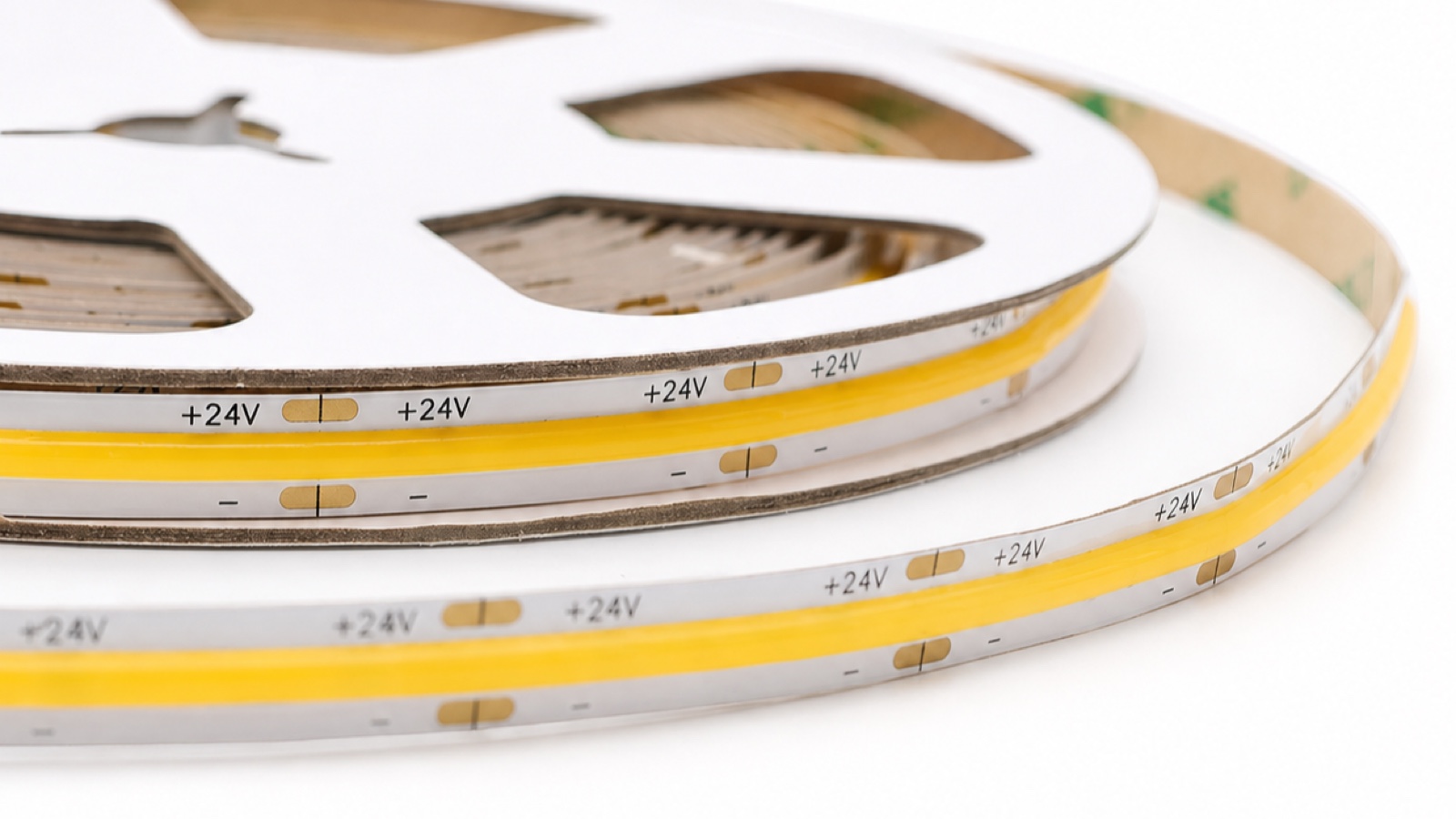
A COB LED strip for cove lighting is a strong starting point when the cove has limited mixing distance or the reflected source image must look continuous. The high chip density and continuous phosphor layer used in COB designs can produce a smoother line than conventional, lower-density SMD strips.
That does not make every COB strip automatically “dotless” in every installation. The result still depends on the exact product, power level, cove geometry, diffuser or profile, surface reflectance and viewing angle. Buyers should use “continuous-looking” as a performance target and approve it in the real detail.
- Hotel, residential and hospitality coves with shallow ceiling details.
- Retail shelves or display coves where reflections can expose LED points.
- Narrow profiles or joinery details where source-to-diffuser distance is limited.
- Projects that prioritize a smooth white light line over the lowest initial strip cost.
For quotation, confirm the exact voltage, power per meter, luminous flux, CCT, CRI, color consistency, PCB width, cut interval, reel length, maximum permitted run per feed, operating temperature and mounting requirement. Wismart's COB Strip Lights include low-voltage, ultra-narrow, free-cut, CCT, RGB/RGBW and single-color purchasing routes; the final values must come from the selected model's specification.
When SMD is the better commercial choice
An SMD LED strip for indirect cove lighting remains a practical choice when the cove is deep enough to hide the source, the project needs broad output or control options, or the buyer is balancing performance with a distributor or project budget.
- Deep commercial coves with adequate distance to the illuminated surface.
- Office, corridor and public-area projects where output and efficacy are primary.
- Distributor programs that need broad CCT, CRI, voltage, RGB/RGBW or protected options.
- Projects using a tested aluminum profile and diffuser combination.
SMD uniformity cannot be judged from the package name alone. LED density, package size, spacing, output, profile depth, diffuser transmission, surface finish and viewing angle all influence whether points or scalloping are visible. A high-density SMD strip in a well-designed cove can outperform a poorly matched COB product for the required task.
For the RFQ, identify the SMD family, LEDs per meter, confirmed watts and lumens per meter, CCT, CRI, PCB width, cut section, voltage, IP structure and control method. Wismart's SMD Strip Lights cover mainstream white, high-CRI, tunable-white, color-control, protected, long-run and project-specific routes.
When silicone protection is justified
A silicone-protected LED strip for a humid cove should be selected because the environment and installation method require protection, not because silicone is assumed to be a better light engine. The internal source can still be COB or SMD.
- Bathrooms, spas and hospitality areas with credible condensation or cleaning-splash risk.
- Dusty ceiling slots or semi-exposed architectural details.
- Visible or touch-accessible lines that need a protected outer surface.
- Curved or integrated linear details that require a defined silicone profile.
An IP number on the strip body is not enough to approve the installation. Buyers should confirm the complete assembly: cut-end treatment, end caps, cable entry, connectors, joints, mounting clips or channels, bending limits, drainage, driver location, UV and chemical exposure, ambient temperature and maintenance procedure. Field cutting or incorrect sealing can change the protection achieved by the finished system.
Silicone construction can also change cross-section, bend direction, minimum bend radius, light transmission, thermal behavior and installation space. Review the exact profile drawing before ordering. Wismart's Silicone Strip Lights are organized by encapsulated, IP67 tube, integrated linear and outdoor-protected project routes.
COB versus SMD: compare measurable project outcomes
| Buying factor | How to compare it correctly |
|---|---|
| Visual uniformity | Install each candidate in the actual cove section and inspect from normal viewing positions. |
| Output | Compare maintained lumens and the resulting ceiling or wall illumination, not watts alone. |
| Color quality | Confirm CCT tolerance, CRI requirement and batch consistency for the selected model. |
| Thermal performance | Test at intended power, ambient temperature, mounting surface and enclosure condition; follow model limits. |
| Run length | Use the manufacturer's maximum feed length and calculate conductor size, feed points and voltage drop for the project. |
| Installation fit | Check PCB width, cut interval, corner treatment, profile, diffuser, adhesive or clips and service access. |
| Commercial fit | Compare sample approval, MOQ, batch control, lead time, warranty basis, packaging and replacement strategy. |
Voltage, power feeds and dimming must be designed as a system
For the same power, a 24V strip draws about half the current of a 12V strip. This often makes 24V practical for longer low-voltage cove sections, but it does not remove voltage drop or create a universal maximum run. The selected strip's power, conductor length and cross-section, connection method, feed direction and allowable brightness variation still decide the layout.
Dimming labels also need system-level verification. PWM, 0-10V, DALI or phase-cut control normally involves a compatible constant-voltage driver and/or controller; it is not an intrinsic capability that can be assigned to every strip. Confirm the strip voltage and load, driver capacity and derating, control protocol, controller current rating, minimum dimming level, flicker performance and behavior with the specified control equipment.
If a high-voltage strip route is considered, treat it as a separate project-specific system. Use the matching product, connectors and protection accessories, and verify local electrical rules, certification and installation requirements with qualified personnel.
Build a representative cove-lighting sample
A short hand sample can confirm color and basic appearance, but it cannot approve a complete cove. Request enough material to reproduce the most critical section of the real detail, including the shallowest distance, tightest return, longest relevant feed condition or most reflective surface.
- Use the intended cove dimensions, surface color and finish.
- Install the proposed profile, diffuser, adhesive, clips or silicone mounting accessories.
- Use the intended driver, controller and cable route.
- Inspect the light line from seated, standing and approach sightlines.
- Measure or compare output at the project dimming levels.
- Operate the mock-up at intended power and representative ambient conditions, then check against the product's thermal limits.
- For protected products, verify end sealing, cable exits, joints and mounting without assuming the strip-body IP rating covers the complete installation.
RFQ checklist for LED strip cove-lighting projects
| RFQ input | Information to send |
|---|---|
| Project and application | Hotel, residential, retail, office, corridor, bathroom, covered exterior or distributor stock. |
| Cove drawing | Section dimensions, strip position, aiming direction, setback, surface finish and viewing angle. |
| Lighting target | Decorative glow, ambient light or indirect general lighting, with target output or photometric requirement. |
| Light engine | COB, SMD or supplier recommendation based on the drawing and sample target. |
| Protection structure | Dry indoor, humid, splash, dust, semi-exposed or outdoor condition; required IP and sealing method. |
| Electrical data | Voltage, watts per meter, section lengths, total quantity, feed points, cable lengths and driver locations. |
| Light quality | CCT, CRI, color consistency and batch-matching requirement. |
| Control | On/off, required dimming protocol, low-end target, RGB/RGBW or tunable-white system. |
| Mechanical fit | PCB/profile width, cut interval, diffuser, corner detail, bend requirement, clips and cable-exit direction. |
| Commercial requirements | Sample plan, quantity, destination market, certifications, labeling, packaging, lead time and warranty expectation. |
Review Wismart cove-lighting product routes
Use Wismart COB Strip Lights when smooth source appearance or compact profile fit is the first decision. Use Wismart SMD Strip Lights when the project needs broad white-light, control, output or commercial options. Review Wismart Silicone Strip Lights when protection structure and exposure drive the selection.
For model-level review, download the COB Strip Light Catalog, SMD Strip Light Catalog or Silicone / Neon Catalog. Send the cove drawing and project data through the cove-lighting sample and quotation form so the sample and datasheet can be matched to the actual installation.
Frequently asked questions
Is COB always better than SMD for cove lighting?
No. COB is often the stronger starting point for short mixing distances and smoother source appearance. SMD can be the better project choice when the cove is deep, the source is concealed, and output, efficacy, controls, availability or cost are more important. Approve the result in the actual cove detail.
Is silicone LED strip a separate LED technology?
No. Silicone describes the encapsulation, tube or integrated profile around a light engine. The internal LEDs may be SMD or COB. Specify the light engine and the protection structure separately.
Is an IP67 strip automatically suitable for every wet cove?
No. Suitability depends on the complete installed assembly, including cut ends, end caps, cable entries, connectors, joints, mounting, drainage, environmental exposure and driver location. Confirm the exact product instructions and local project requirements.
What sample should a B2B buyer request?
Request enough of each candidate to reproduce the most critical part of the real cove. Use the intended surface, profile or silicone mounting system, driver, controller and cable layout. Compare source visibility, reflected uniformity, output, dimming behavior, installation fit and thermal conditions before bulk approval.
Conclusion
The correct LED strip for cove lighting is a system decision. Choose COB or SMD by geometry, visual uniformity, output, color quality, installation fit and commercial requirements. Then add the protection structure required by the real environment. Do not approve “silicone,” “24V” or “dotless” as standalone labels without checking the exact model and complete installation.
Review COB Strip Lights, SMD Strip Lights and Silicone Strip Lights. Then request a matched datasheet, project sample and quotation using the cove drawing, target CCT/CRI, output, voltage, run lengths, IP requirement and control system.