
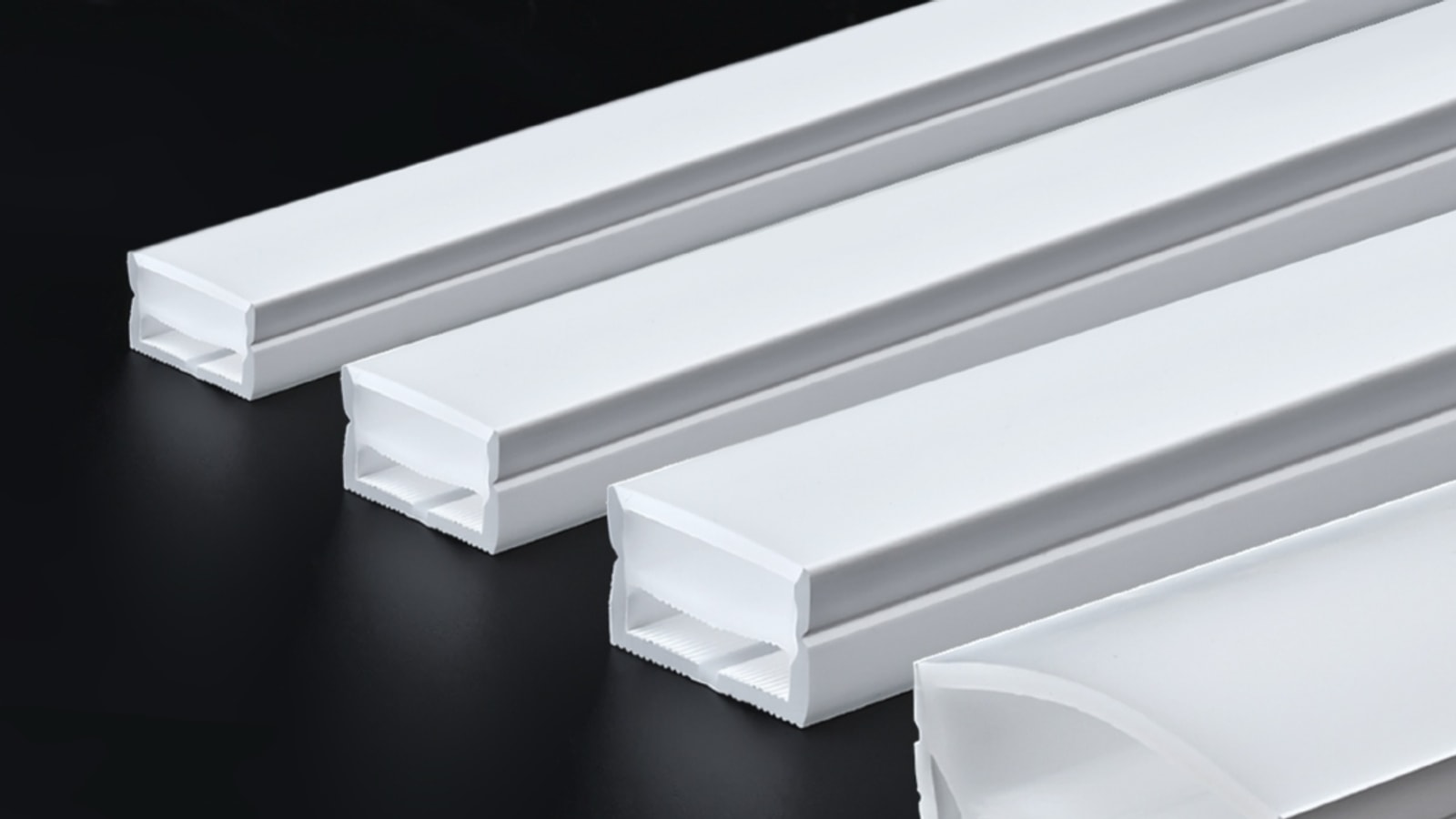
An LED strip that “turns yellow” may be showing one of several completely different changes. The transparent coating may have discolored. The white light may have shifted to a warmer chromaticity. An RGB strip may have lost part of its blue output. Or the far end of a long run may be receiving too little voltage.
These problems can look similar in a photograph, but they do not share one cause or one solution. The fastest way to understand the change is to separate what has become yellow: the material, the emitted light, one section of the circuit, or something around the strip.
The short answer
LED strip lights can appear yellow because of:
- heat- or UV-related discoloration of a coating, encapsulant, diffuser, adhesive, or nearby surface;
- gradual chromaticity shift inside the LED package as phosphors, binders, reflectors, or molding materials age;
- volatile chemicals, sulfur-containing materials, cleaning agents, sealants, or other contaminants interacting with LED optical materials;
- voltage drop along a long RGB or addressable strip, which can reduce blue and green output more visibly than red in some architectures;
- a failed blue channel, damaged copper trace, poor connection, or controller fault in an RGB system;
- an unintended warm-white setting or unequal warm/cool channel output in a tunable-white system; or
- dirt, smoke, grease, dust, or a yellowed diffuser changing the light after it leaves the LEDs.
Heat is important because it accelerates many aging mechanisms, but heat does not make every LED shift in the same direction. Some packages shift toward yellow, while others may shift toward blue or green. The materials and electrical architecture have to be considered before assigning a cause.
First identify what “yellow” means
Turn the strip off and inspect it under neutral white light. Then turn it on and compare the beginning, middle, and end of the run. This simple observation separates several failure paths.
| What you observe | More likely explanation |
|---|---|
| The clear coating, COB phosphor layer, tube, or diffuser looks yellow while the strip is off | Physical discoloration, contamination, or material aging |
| The strip looks normal when off, but its white light has gradually become warmer | LED-package chromaticity shift, thermal aging, or a control-setting change |
| Only the far end looks dimmer, redder, brownish, or yellowish at high brightness | Voltage drop or inadequate power distribution, especially on some RGB pixel strips |
| One RGB section suddenly produces yellow when white is selected | Missing or weak blue channel, damaged trace, connector problem, solder fault, or controller-output fault |
| The strip looks correct without the cover but yellow through the profile | Yellowed, dirty, or chemically affected diffuser |
| Two new reels look different even though both are marked 3000K | Initial binning or color-tolerance difference, not necessarily aging |
How a white LED produces white light
Most white LEDs do not emit a complete white spectrum directly from one semiconductor junction. A common construction starts with a blue LED chip. Part of the blue light passes through a phosphor system that converts some of that energy into longer wavelengths. The remaining blue and converted light combine and are perceived as white.
This balance determines the initial color temperature and spectral distribution. It also means that color can change if any part of the optical system changes:
- the blue-emitting chip;
- the phosphor composition;
- the binder that holds the phosphor;
- the silicone lens or encapsulant;
- the package reflector or molding compound; or
- the transparent material placed over the finished strip.
White COB strips use many closely spaced chips under a continuous phosphor-conversion and encapsulation layer. White SMD strips use discrete packaged LEDs. Both can provide stable white light when properly designed, but neither construction is immune to material, thermal, chemical, or electrical stress.
Heat can accelerate permanent material and color change
LEDs are efficient, but they still produce heat. Electrical energy that does not leave as visible light must move through the LED package, solder joints, flexible PCB, mounting surface, and surrounding air.
High operating temperature can accelerate oxidation, polymer discoloration, phosphor-binder damage, reflector degradation, solder fatigue, and lumen depreciation. In some phosphor-converted LED packages, prolonged thermal and optical stress can cause the phosphor-binder layer to crack or separate from the chip. The changed optical path alters how much blue light is converted, and the emitted color may move toward yellow.
That is one possible mechanism, not a universal rule. Other package materials and phosphor systems can shift toward blue or green. A temporary color change while the strip is hot is also different from a permanent change that remains after the strip cools.
A useful comparison is therefore:
- measure or photograph the strip shortly after a cold start;
- repeat the observation after it reaches a stable operating temperature; and
- check it again after it has been switched off and fully cooled.
If the original color returns after cooling, the result may be temperature-dependent behavior. If the change remains, permanent aging, contamination, or damage is more likely.
The coating or diffuser may be yellow, even when the LEDs are not
The visible yellow color may come from material outside the LED package. Possible locations include:
- a waterproof coating over an SMD strip;
- the continuous encapsulation layer on a COB strip;
- a silicone tube or extrusion;
- an epoxy, polyurethane, or other protective resin;
- an adhesive or potting compound near the LEDs; or
- the diffuser in an aluminum profile.
Transparent polymers do not all age in the same way. UV exposure, heat, oxygen, humidity, chemical contact, and formulation quality all affect optical stability. Optical-grade silicone is generally selected for better heat and UV stability than many traditional transparent resins, but “silicone” alone does not guarantee zero yellowing. The precise grade, additives, cure, processing conditions, cleanliness, and complete assembly still matter.
If the strip looks yellow when it is switched off, but the bare LED output remains normal after the cover is removed, the optical material should be investigated before blaming the LED chips.
Chemicals and contaminants can change optical materials
LED lighting assemblies are not chemically isolated. Some silicone optical materials are permeable to gases. Volatile organic compounds can come from adhesives, sealants, cleaning agents, paints, plastics, foam, cable materials, solder flux, oils, or surrounding furnishings.
Under heat and intense blue light, incompatible compounds may discolor an encapsulant or deposit on optical surfaces. Some effects can be partly reversible after ventilation and operation; others become permanent. The response depends on the chemical, concentration, temperature, enclosure, exposure time, and LED package.
Sulfur-containing materials create a separate reliability risk. Sulfur can corrode silver-containing surfaces used inside some LED packages, reducing reflectivity and changing light output. A darkened or discolored package is therefore not always ordinary “silicone yellowing.”
For this reason, a strip that performs well in open air may age differently inside a sealed cabinet, sign enclosure, refrigerated display, freshly painted profile, or assembly containing an untested gasket or adhesive.
Voltage drop can make the end of an RGB strip look yellow or red
If the color change follows the length of the strip, the cause may be electrical rather than chemical.
Current flowing through copper traces and connecting wires produces a voltage drop. The farther a section is from the power feed, the less voltage may be available under load. On some common 5V addressable RGB strip architectures, blue and green output are affected more visibly than red as voltage falls. A white command can therefore become redder, brownish, or yellowish toward the far end.
This behavior is not identical across all RGB products. Some pixel-driver designs regulate color and brightness over a wider supply range, and analog RGB, RGBW, 12V, and 24V circuits respond differently. The correct test is to measure the supply voltage at the start and far end while the strip is displaying the highest-load color and brightness actually used.
When the far end returns to the correct color after the power distribution is corrected, the strip did not suffer optical yellowing. It was operating outside the intended electrical condition.
For a deeper explanation, see Wismart's article on LED strip power supplies and voltage drop.
Yellow from an RGB strip can mean the blue channel is missing
RGB light creates yellow by combining red and green. It creates an approximate white by combining red, green, and blue. If the blue channel becomes weak or stops conducting, a white command may appear yellow.
If the change occurs suddenly in one section rather than gradually along the run, inspect:
- the blue-channel copper trace;
- solder joints and cut points;
- connectors and wire order;
- the controller's blue output;
- a damaged RGB package or pixel driver; and
- software color order on an addressable strip.
A failed blue channel is a circuit fault, not phosphor aging. Replacing a yellowed diffuser or changing silicone will not correct it.
Tunable-white controls can create an unintended warm shift
A tunable-white strip normally combines a warm-white channel and a cool-white channel. The final correlated color temperature depends on their relative output. A changed preset, mismatched dimming curve, weak cool-white channel, loose connection, or controller fault can make the light look warmer even when the LEDs have not materially aged.
Test each channel separately before concluding that the phosphor has changed. If both channels produce their expected colors independently but the mixed setting is wrong, the cause is probably in the controller, calibration, or software rather than the strip's optical materials.
The room can turn the light yellow
Light is judged after it interacts with the installation. A yellowed polycarbonate diffuser, nicotine or cooking residue, construction dust, warm-colored paint, wood reflection, aged adhesive, or dirty cover can all change the observed color.
Compare the strip without the diffuser and against a neutral white surface. If possible, use a portable spectrometer or color meter at a fixed position. Camera auto white balance is not a reliable diagnostic tool because it may correct or exaggerate the difference between samples.
Is LED strip yellowing reversible?
It depends on the mechanism.
| Cause | Usually reversible? |
|---|---|
| Incorrect RGB, RGBW, or tunable-white setting | Yes, if the hardware is undamaged |
| Voltage drop or poor connection | Often, after the electrical fault is corrected |
| Dust, grease, or removable surface contamination | Sometimes, using a material-compatible cleaning method |
| Yellowed diffuser | Usually requires diffuser replacement |
| Polymer oxidation or permanent heat discoloration | Usually no |
| Phosphor-binder damage or package degradation | No practical field repair |
| Sulfur corrosion inside the LED package | Generally no practical field repair |
| VOC-related discoloration | May be partly reversible in some packages, but should not be assumed |
Do not clean LED strips with an unapproved solvent. A cleaner that removes surface dirt may also attack silicone, polycarbonate, adhesives, solder mask, or printed markings.
How color stability is evaluated
Visual inspection is useful, but controlled measurements provide stronger evidence. A technical evaluation may include:
- CIE chromaticity coordinates before and after aging;
- correlated color temperature, while recognizing that CCT alone does not describe the direction or size of every color shift;
- chromaticity difference such as delta u'v';
- spectral power distribution;
- luminous flux or illuminance change;
- photographs taken with fixed exposure and white balance;
- voltage measurements at several points under load;
- thermal measurements at a defined ambient temperature and mounting condition;
- high-temperature operating-life, temperature-humidity, UV, or chemical-compatibility tests; and
- retained samples from the original production batch.
LM-80 data can help describe lumen and chromaticity maintenance of an LED light source, such as a package, array, or module, under stated test conditions. It does not by itself prove the lifetime or color stability of a complete LED strip, because the finished strip also includes PCB materials, solder joints, resistors or drivers, coatings, adhesives, connectors, power electronics, and the installation environment.
A practical diagnosis sequence
When an LED strip appears yellow, use this order:
- Switch it off and inspect the materials. Look for yellow coating, darkened packages, residue, or a discolored diffuser.
- Remove or isolate the optical cover. Determine whether the color change is inside the strip or after the light leaves it.
- Compare the beginning and end under full load. A lengthwise gradient points toward voltage distribution.
- Test RGB or tunable-white channels separately. A missing channel can imitate material aging.
- Measure voltage while operating. An unloaded power-supply reading cannot show the voltage available at the far end under real current.
- Compare cold and thermally stable output. This separates reversible temperature behavior from a persistent change.
- Review the surrounding materials. Check recent paint, sealant, adhesive, foam, rubber, cleaning chemicals, smoke, oil, and enclosed-air conditions.
- Compare with a retained sample. Use the same batch, power condition, diffuser, and measurement geometry whenever possible.
Stop using the installation and have it inspected if the strip, connector, wiring, or mounting surface is excessively hot, browned, deformed, producing odor, or showing intermittent electrical behavior. A yellow appearance alone does not prove a safety hazard, but visible heat damage should not be treated as a cosmetic issue.
Frequently asked questions
Do all silicone LED strips eventually turn yellow?
No. Optical stability depends on the silicone formulation, additives, cure, processing quality, temperature, UV exposure, chemical environment, and complete product construction. High-quality optical silicone is designed to resist yellowing, but no material label can replace application-specific aging evidence.
Does heat always make a white LED look more yellow?
No. Temperature can change LED output temporarily, and long-term heat accelerates aging, but the direction of permanent color shift depends on the chip, phosphor, binder, reflector, package material, and failure mechanism. Yellow, blue, and green shifts have all been observed in LED packages.
Why does an RGB LED strip show yellow when white is selected?
Yellow normally means red and green are present while blue is missing or too weak. Possible causes include a damaged blue channel, connector or trace fault, controller problem, wrong color order, or voltage drop in certain RGB architectures.
Why is only the end of the strip yellow?
When the shift develops gradually toward the far end and becomes worse at high brightness, voltage drop is a strong possibility. Measure the voltage at both ends under load before assuming the LEDs or coating have aged.
Can a yellowed LED strip be cleaned?
Surface contamination may be removable, but oxidized polymer, damaged phosphor material, corroded package surfaces, and permanent heat discoloration cannot normally be cleaned away. Use only a cleaning method confirmed as compatible with the strip materials.
Conclusion
“Yellow LED strip” is a visual symptom, not a complete diagnosis. A yellow coating while the strip is off points toward material or contamination. A gradual change in emitted white may involve package aging or thermal stress. A red-yellow gradient along an RGB strip may be electrical, while one suddenly yellow section may have lost its blue channel.
Separating these mechanisms prevents the wrong corrective action and produces better evidence for future product design. Wismart's SMD Strip Lights, COB Strip Lights, and Silicone Strip Lights pages show the main construction routes discussed in this article.
For a technical review, send clear powered and unpowered photos, product structure, voltage, power per meter, run length, feed locations, installation temperature, exposure conditions, and the time required for the change to appear. Wismart can use that information to discuss relevant specification data, compare a retained or new sample, and prepare a quotation when replacement or a new project is required through the LED strip color-stability contact form.